

Selling liquidation on Poshmark requires translating a wholesale lot into individual items buyers can evaluate. A pallet description may explain the source and overall condition mix, but it does not establish the condition, authenticity, measurements or completeness of every garment or pair of shoes.
Poshmark is an online marketplace: a platform where independent sellers publish listings and transact with buyers under platform rules. Before sourcing apparel or footwear, connect those rules to your inspection capacity, storage space and listing schedule. For the broader purchasing process, start with our guide to buying liquidation pallets.
This guide focuses on the work between buying inventory and publishing accurate Poshmark listings: checking current requirements, separating sellable items, documenting condition and deciding when individual listings or bundles make sense.
Check current Poshmark rules before buying inventory
Do not rely on an old seller tutorial for current fees, permitted merchandise or shipping limits. Open Poshmark’s official Help Center, prohibited-items guidance, terms and shipping instructions for the market where your account operates. Record the date checked and revisit the guidance before changing categories or listing formats.
Confirm these points before committing to a lot:
- Whether the exact product category and item condition are permitted, including any restrictions affecting intimate apparel or hygiene-sensitive merchandise.
- Current selling fees, offer mechanics and seller-funded discounts.
- Shipping-label weight and package limits, upgrade procedures and restrictions on combined orders.
- Current requirements for authenticity, brand identification, photographs and listing descriptions.
- Buyer-protection procedures, seller response deadlines and how not-as-described complaints are handled.
- Rules governing payment, communications and prohibited attempts to move transactions off-platform.
Liquidation sourcing does not exempt a seller from marketplace rules. An invoice documents a purchase; it does not, by itself, authenticate every branded item. Quarantine questionable merchandise rather than guessing about authenticity or using a disclaimer to justify listing it.
Keep two shipping systems separate: PalletCove’s inbound delivery of your wholesale order and Poshmark’s outbound shipping requirements for your customer orders. The terms of one do not determine the other.
Choose apparel and footwear loads you can actually process
A liquidation pallet is a bulk unit of merchandise offered as one lot. A truckload is a larger shipment that may occupy a full trailer. Category-level inventory narrows the merchandise type, but it does not necessarily provide a predictable size run, style mix or condition mix.
Review the liquidation pallets hub and compare liquidation pallet types before choosing a sourcing format. A larger load increases receiving, inspection, photography and storage work—not simply your number of potential listings.
Read the condition grade and manifest together
A condition grade is the supplier’s description of merchandise condition. Labels are not universally standardized, so the actual listing language controls. A manifest is an inventory document that may identify products, quantities, sizes or other details; determine what it includes and whether its counts are represented as exact or estimated.
| Listed inventory term | What to establish before ordering | Poshmark preparation implication |
|---|---|---|
| --- | --- | --- |
| Overstock | Actual listed condition, tag status and storage effects | Do not assume every unit qualifies as new |
| Shelf pulls | Handling wear, stickers, packaging and missing tags | Inspect visible surfaces and photograph relevant wear |
| Customer returns | Known defects, use, completeness and inspection scope | Examine every item before assigning condition |
| Mixed condition | Included condition categories and any exclusions | Budget time for multiple sorting outcomes |
| Salvage | Stated damage and intended recovery use | Do not assume ordinary wearable inventory |
| As-is | Exactly what the listing and claims terms cover | Treat unknowns as purchasing risks, not listing facts |
A manifest’s retail values are not evidence of achievable Poshmark prices. Check quantities against distinct styles, sizes and colors, and ask whether footwear quantities mean pairs or individual shoes.
The Macy’s inventory category and new-arrival liquidation inventory provide starting points for reviewing actual offers. Compare the Macy’s Textile Truckload with the Shoes Truckload only after reading their current descriptions. A textile title does not establish that all contents are wearable apparel, and a footwear title does not establish brands, sizes or condition.
PalletCove is an independent reseller and is not affiliated with, endorsed by or sponsored by any retailer named.
Build a buying limit around listing-ready units
Your pricing strategy is the method used to set asking prices, evaluate offers and revise prices over time. It should start before purchasing, using comparable sold items where available—not only active asking prices.
Compare brand, style, size, condition, season and completeness. Footwear missing an original box is not automatically equivalent to a boxed pair; a tagged garment with damage is not equivalent to an undamaged example.
Use a planning worksheet with separate lines for:
- The listed lot price, with inbound freight included.
- Inspection, permitted cleaning, repairs and preparation labor.
- Photography, measurements and listing labor.
- Packaging, current platform fees and any seller-funded shipping discounts.
- Storage, returns exposure and inventory that may remain unsold.
For example, a hypothetical $1,200 lot containing 100 units averages $12 per received unit. If only 60 units qualify for your planned Poshmark listings, allocating the entire purchase cost to those units produces a $20 inventory burden per listing-ready unit, before other expenses. Neither figure predicts profit.
Our liquidation pallet pricing and buying-limit guide covers purchase ceilings in more depth. Scale from pallets to truckloads only when your records show that receiving, listing and fulfillment can keep pace.
Order with receiving space and delivery timing in mind
Before payment, save the listing, manifest if supplied, condition description and applicable claims terms. Confirm the lot identifier, quantity basis, receiving address and whether your site can accept the stated shipment format.
LTL means less-than-truckload freight, where a shipment shares trailer capacity with other freight. A full trailer requires a different receiving plan. Ask what unloading arrangements the specific order requires; do not assume special equipment or a particular advance-call schedule.
PalletCove’s only delivery option is free shipping on every order to all 48 contiguous states, with freight included in the listed price. This applies to buyers researching liquidation pallets in Texas and liquidation pallets in Florida, as well as other contiguous-state destinations.
Handling takes 1–3 business days after payment clears. Transit from Dallas is typically 3–7 business days, giving an estimated 4–10 business days total. The processing cutoff is 2:00 PM Central Time, America/Chicago, Monday–Friday; after-cutoff confirmations begin the next business day. Weekends and applicable holidays do not count.
Use the payment methods shown at checkout: card via a secure payment link, ACH, bank wire and the listed payment apps. Valid resale certificates are reviewed and applied where the buyer’s state allows.
Inspect delivery and create an item-level condition record
Photograph the shipment’s exterior, labels and visible damage before breaking it down when practical. Record discrepancies on delivery paperwork where applicable, retain relevant packaging and compare received merchandise with the order documents.
PalletCove requests delivery-issue reporting within 48 hours. Send clear photographs, the order identifier and a factual description rather than waiting until every item has been listed.
Under the United States Refund & Returns Policy, products explicitly listed as NEW ONLY qualify for defective and non-defective returns and exchanges within 30 calendar days of delivery. Returns are by mail; the customer is responsible for the return label and shipping, and the restocking fee is 15% of the product price. Refund processing takes 10 calendar days after authorized return receipt and inspection, or approval where no physical return is required. Mixed/used loads have separate claims terms, not routine change-of-mind returns; the requested 48-hour delivery reporting does not shorten eligible new-product 30-day returns.
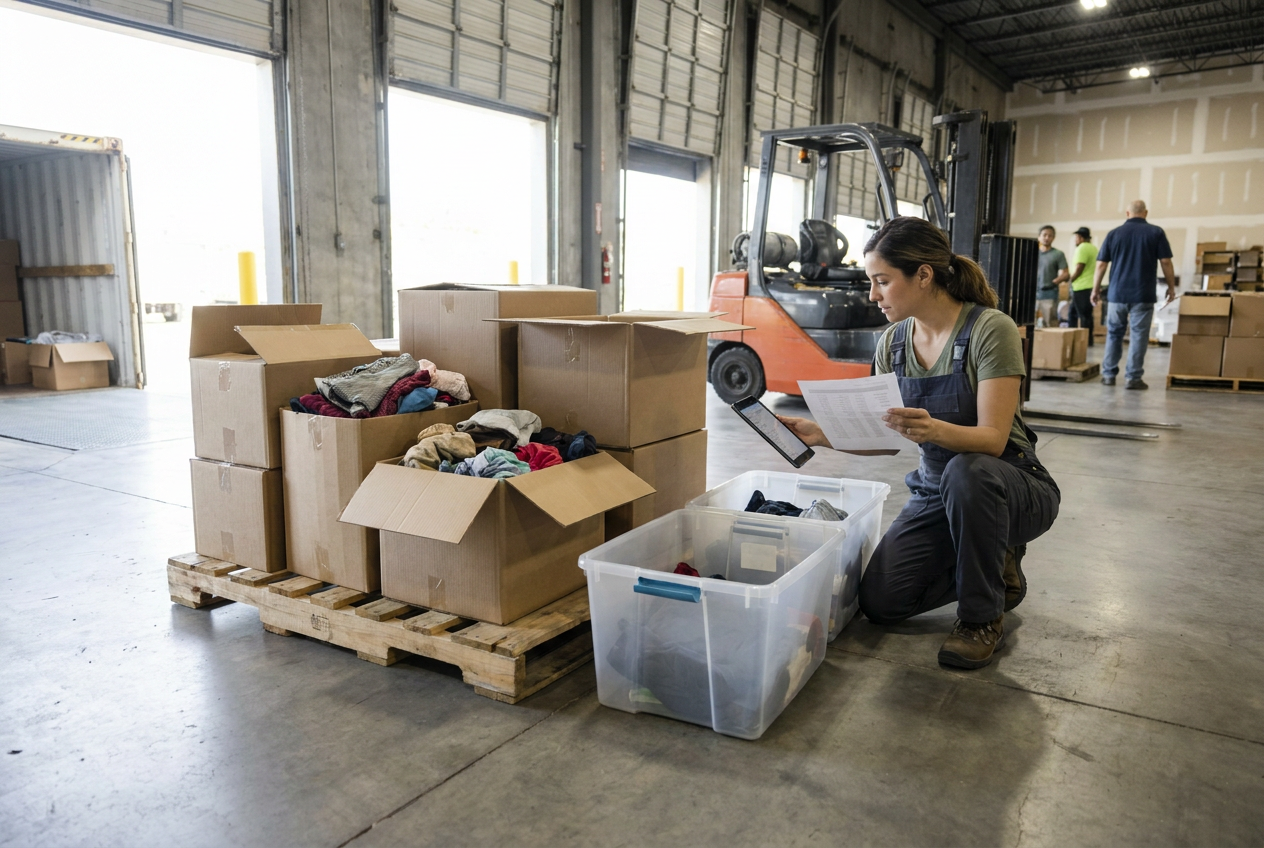
Sorting means separating inventory by verified characteristics and next action. Assign each unit a unique stock-keeping identifier, or SKU, and use four working groups: ready to list, needs preparation, needs investigation and unsuitable for the planned channel.

For apparel, inspect seams, closures, lining, hems, stains, odors, alterations, size labels and care labels. For footwear, check matching sizes, left/right pairing, soles, uppers, insoles, closures and visible deterioration. Record what you observed without claiming comprehensive testing or hidden-condition certainty.
Store the SKU, storage location, label size, measurements, defects, photo filenames and preparation status in one inventory sheet. Preserve original condition photographs before cleaning or repairs, and follow material-care instructions.
A wholesale condition description is a sourcing input—not a substitute for inspecting and describing the individual item you sell.
Turn inspection records into accurate individual listings
Use a repeatable online marketplace listing workflow: inspect, identify, measure, photograph, draft, verify and publish. Batch similar tasks, but keep each item’s records and photographs attached to its SKU.
A useful listing contains:
- Title: verified brand, item type, distinguishing style, labeled size and color.
- Condition: factual observations, tag status, wear and every material flaw.
- Measurements: measurement method and relevant dimensions rather than an unsupported fit promise.
- Contents: exactly what the buyer receives, including whether accessories or an original shoe box are included.
- Photos: the actual item, labels, identifying details and close-ups of disclosed flaws.
- Internal record: SKU, cost allocation, storage location and publication date.
For garments, useful measurements may include pit-to-pit width, length, waist, rise and inseam, depending on the item. State whether measurements were taken flat and avoid translating a missing label into a definitive manufacturer size. For shoes, photograph size markings and specify the sizing system shown rather than making an uncertain conversion.
An effective condition note might read: “Pre-owned jacket with light cuff wear and a small mark near the lower front; both shown in close-up photos. Zipper opens and closes during inspection. See flat measurements.” Use statements like these only when supported by your own observations.
Avoid copying supplier photographs as though they show your exact unit. Do not publish “new with tags” merely because the lot was called overstock. Recheck every listing against its photos before publication, especially when templates could carry one item’s details into another.
Organize bundles without losing item-level disclosure
Distinguish Poshmark’s current native Bundle functionality from a single listing containing several items. Verify the current rules for each approach, including checkout behavior, shipping limits and available listing fields.
Bundle by a clear buyer need: compatible labeled sizes, a coordinated clothing group or similar-use items. Do not use bundles to conceal undesirable pieces or shift inspection work onto the buyer.
For a multi-item listing, identify each included piece, its size and its condition. Photograph the complete group and individual defects, then weigh the packed shipment before committing to a shipping arrangement. Explain whether the items are sold only together.
Prevent duplicate sales by reserving or removing component listings when their items become unavailable. Keep bundle identifiers linked to the underlying SKUs so you can locate every piece during packing.
Route inventory that does not suit Poshmark deliberately. A bin store is a retail format where shoppers browse merchandise in bins, often under a scheduled pricing model. A flea market is a venue where independent vendors sell from booths or stalls; our guide to selling liquidation at flea markets covers that separate channel. Neither outlet makes unsafe or prohibited merchandise appropriate to sell. Isolate unsellable items and evaluate lawful return, recycling or disposal options.
Frequently asked questions
Can liquidation apparel be sold on Poshmark?
Liquidation sourcing alone does not determine eligibility. Check the current rules for the exact item, then verify authenticity, permitted condition and accurate disclosure before listing.
Does overstock mean I can list an item as new?
No. Overstock describes an inventory situation, not necessarily the condition of each unit. Inspect the actual item and use only the condition designation supported by its condition and current platform definitions.
Should I list shoes individually or in bundles?
Individual pair listings usually make size, wear and identifying details easier to evaluate. Consider bundles only when the grouping serves a buyer need and every pair can be documented within current shipping and listing requirements.
How should I price inventory without a detailed manifest?
Treat missing information as uncertainty rather than assuming a favorable mix. Build conservative scenarios for listing-ready quantities and preparation costs, and decline the purchase if the unknowns exceed your capacity or budget.
Are PalletCove returns the same as Poshmark buyer returns?
No. Your wholesale purchase follows PalletCove’s applicable policy and claims terms, while your marketplace transactions follow Poshmark’s current procedures. A buyer complaint on Poshmark does not automatically establish an eligible supplier claim.
Talk to PalletCove Liquidation
Successful preparation for selling liquidation on Poshmark starts with a lot you can inspect, document and organize—not an assumed resale value. Use our liquidation pallet buying guide for the broader purchasing framework, then review the exact inventory description before ordering.
PalletCove Liquidation LLC is located at 4820 Cove Industrial Blvd, Dallas, TX 75236. Call (713) 819-3904 or email sales@palletcoveliquidation.com. Hours are Mon–Fri 8:00 AM – 6:00 PM CT, Sat 9:00 AM – 2:00 PM CT, Sun closed.
To discuss listed conditions and receiving requirements, contact our order desk, or review current inventory for available purchasing options.