
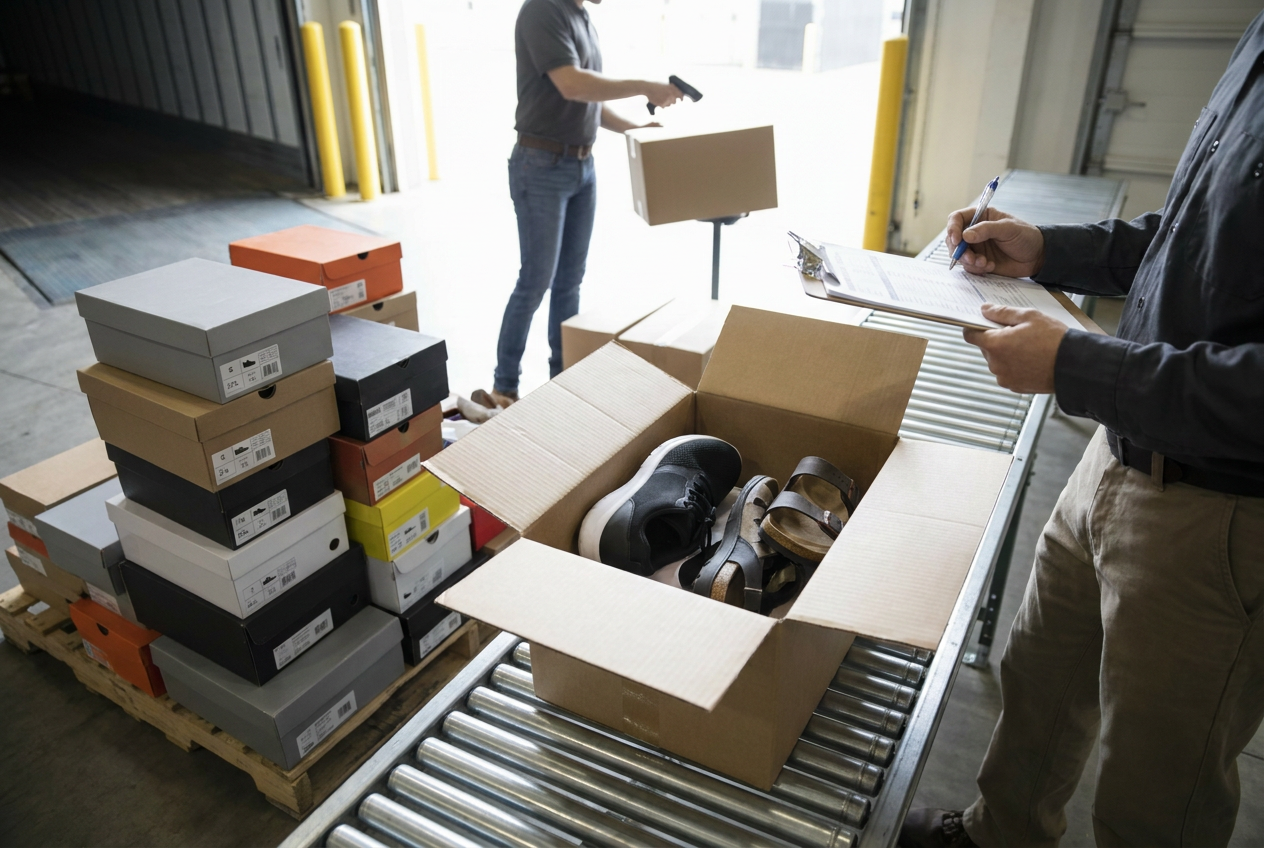
A footwear load can contain recognizable brands and a large unit count while still leaving your customers without shoes they can buy. Too many duplicates in one size, missing middle sizes, and loose shoes without matching partners can make the headline quantity misleading.
Shoe size runs reveal what that quantity actually contains. Before comparing prices, a reseller needs to know how many matched pairs are available in each style, size, width, and condition—not simply how many boxes or individual shoes appear on a manifest.
For the broader category picture, explore our wholesale liquidation load categories. This guide stays focused on assessing footwear assortments so that a liquidation pallet or truckload does not conceal inventory gaps behind its total count.
What shoe size runs tell a footwear buyer
A size run is the sequence and quantity of sizes offered within a particular footwear style or SKU family. A complete run includes every size in a defined range; a broken run has missing sizes. A balanced run has quantities suited to your customers, which is not necessarily an equal number of every size.
For example, having one pair in every size may create a complete run but still understock your most requested sizes. Conversely, several broken runs can work for a reseller whose customers search for individual pairs rather than coordinated style collections.
Keep these distinctions separate:
- Size coverage: Which sizes exist within each style and width?
- Size depth: How many matched pairs are available in each size?
- Pair integrity: Do the left and right shoes match in model, size, width, and color?
- Sale readiness: Does each matched pair meet your condition and disclosure requirements?
A size label is not enough by itself. Record whether sizing is US, UK, or EU and whether it applies to men's, women's, youth, or children's footwear. Preserve the labeled size instead of relying on a universal conversion chart; fit and conversions can vary by manufacturer and model.
A large footwear count is not a usable size run until the counting unit, matching pairs, and size distribution are verified.
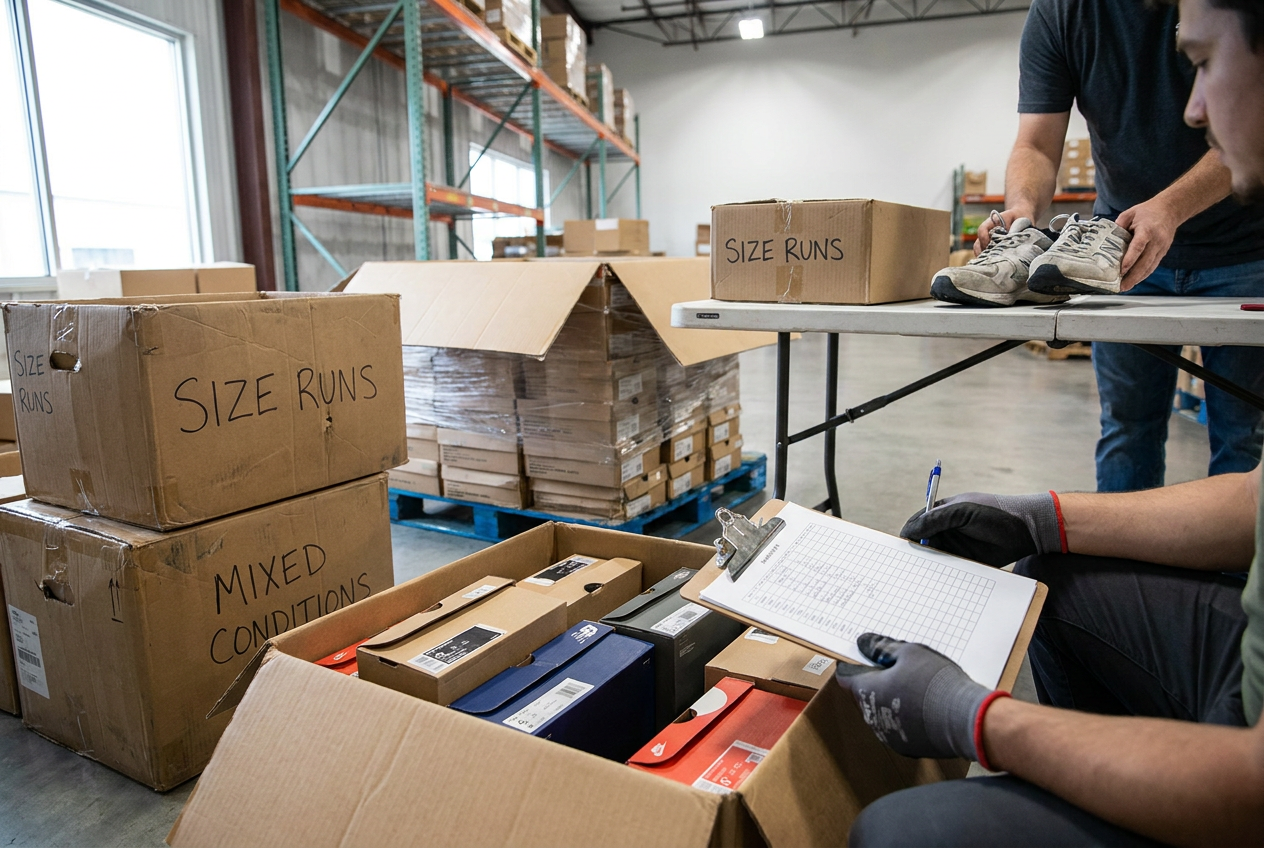
Choose the load format without confusing categories
An apparel and footwear load combines clothing with shoes, but it does not automatically provide a footwear-only assortment. General merchandise means a mixed assortment spanning product categories. Electronics are powered or electronic devices; tools are equipment used for repair, construction, or maintenance; apparel is clothing; HBA means health and beauty aids; and home goods are household-use items such as bedding, décor, and kitchenware.
These distinctions matter because general merchandise pallets, electronics pallets, tool and home improvement pallets, home and personal care pallets, and outdoor power equipment pallets have different inspection needs. Their unit counts are not substitutes for footwear pair counts. The sibling guide to electronics pallet testing costs addresses that category's separate workload.
Compare formats through the types of liquidation pallets guide, then distinguish general merchandise inventory from full truckload inventory. A larger format increases receiving volume, not necessarily assortment quality.
The Shoes Truckload listing is a relevant starting point for footwear volume. A model-specific page such as the AJ1 Lightning Hook Low product listing requires a different check: verify the currently listed size selections and quantities rather than assuming a complete run. Neither a product name nor a listing photograph establishes available sizes, condition, or stock.
For broader pair and packaging checks, use the related footwear liquidation pallets guide. PalletCove is an independent reseller and is not affiliated with, endorsed by, or sponsored by any retailer named.
Audit the manifest at style-and-size level
A manifest is an inventory record describing a load. Its usefulness depends on the fields included and what its quantities represent. Ask whether “units” means individual shoes, matched pairs, boxes, or another counting basis. An empty box and a box containing mismatched shoes cannot support the same inventory assumptions as a verified pair.
Request the most detailed available breakdown. If a field is unavailable, treat it as unknown rather than silently converting it into a favorable assumption.
| Manifest field | What to verify | Why it matters |
|---|---|---|
| --- | --- | --- |
| Style or model | Consistent model identifier | Similar-looking shoes may not form a pair |
| Size and sizing system | Labeled size plus US, UK, or EU | Identical numerals may describe different sizes |
| Department | Men's, women's, youth, or children's | Prevents misleading combined size totals |
| Width | Standard or labeled width designation | Same-size shoes can still mismatch |
| Color | Matching color description or code | Reduces false pair matches |
| Quantity basis | Shoes, pairs, or boxes | Determines the usable denominator |
| Condition and packaging | Listed grade and disclosed exceptions | Separates pair availability from sale readiness |
Build a matrix with styles as rows and sizes as columns. Keep widths and departments separate. Then compare the matrix with your own sales history, requests, and channel restrictions—not an assumed universal “best-selling” size range.
Ask whether photographs represent the specific lot or illustrate the product category. A visible sample can show that a size exists without establishing its quantity throughout the load. Likewise, a sample inspection may help identify risks but cannot verify every pair.
Separate condition grades from pair completeness
A condition grade describes merchandise condition under the listing's definitions. It does not tell you whether the size assortment is balanced. A complete size run can contain damaged pairs; a clean-looking load can consist mostly of fragmented sizes.
Common liquidation descriptions require different questions:
- Overstock: Excess inventory. Confirm the explicit condition, storage effects, and packaging rather than automatically calling it new.
- Shelf pulls: Goods removed from sales displays or shelves. Check for handling marks, labels, and box damage.
- Customer returns: Previously returned merchandise. Wear, missing components, mismatches, and packaging discrepancies may vary.
- Mixed or used: Assess the disclosed range and your capacity to sort and describe each pair accurately.
- Salvage: Evaluate the specifically disclosed limitations. Do not budget as though every item is wearable.
“As-is” describes the offered basis of sale where stated; it is not a universal condition grade or a replacement for applicable policy terms.
For each prospective pair, compare both shoes' labels, soles, uppers, closures, and included components. Check for uneven wear and material damage. Matching boxes are useful, but the shoes inside control the match. Never combine similar-looking left and right shoes merely to increase the pair count.
Maintain separate bins for verified pairs, pairs needing attention, unmatched singles, and items unsuitable for your intended channel. Singles can sometimes be matched elsewhere in the same load, but that possibility is not verified inventory.
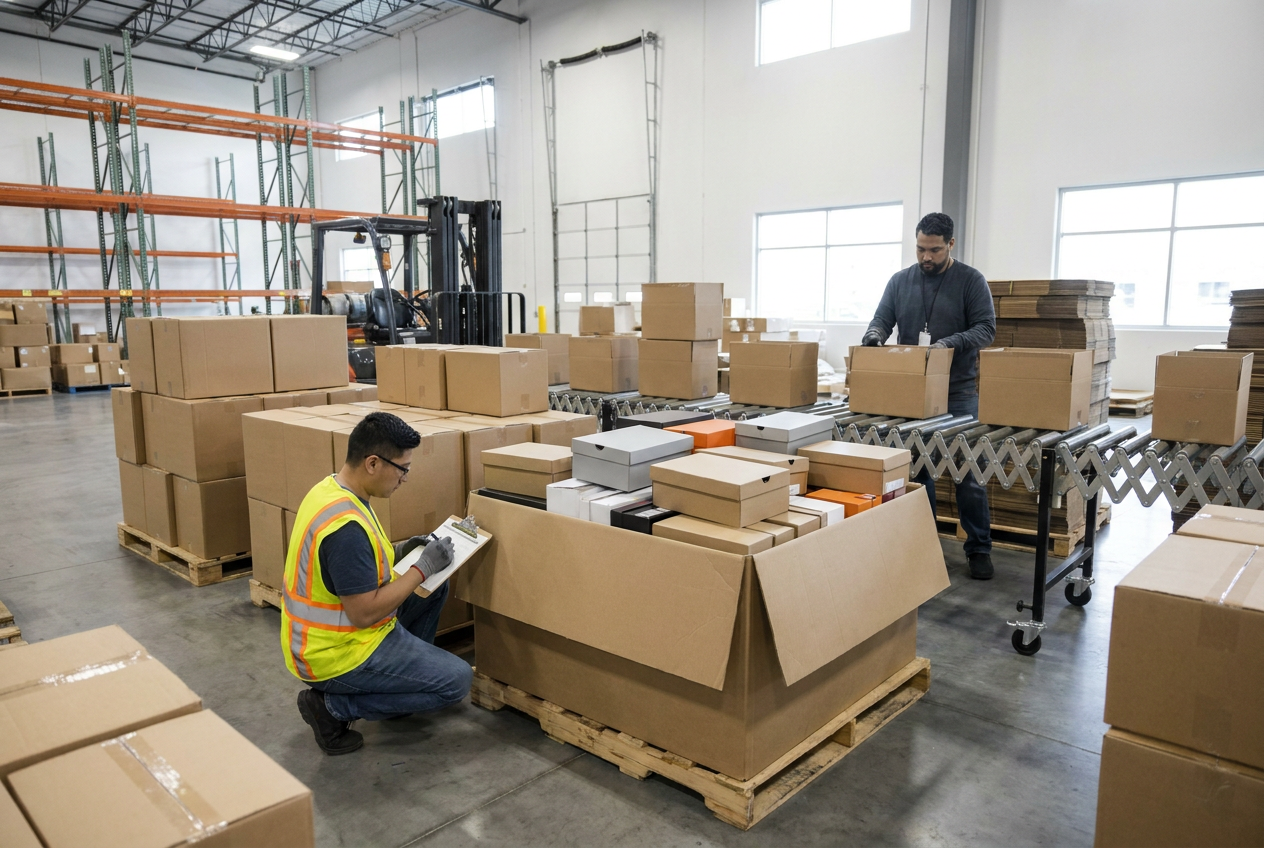
Price the usable assortment, not the headline count
The listed lot price must be evaluated against the inventory you can actually offer. Freight is included in PalletCove's listed price, so do not add a second freight allowance to that price. Separately estimate your own sorting labor, cleaning supplies, packaging, storage, and selling expenses.
Use this planning calculation:
Acquisition cost per verified usable pair = listed lot price ÷ verified usable pairs.
As a hypothetical example, suppose a $3,000 lot contains 300 units explicitly defined as pairs. The initial acquisition cost is $10 per pair. If your inspection finds only 240 matched pairs suitable for your intended channel, the effective acquisition cost becomes $12.50 per usable pair before your own operating expenses. This is arithmetic, not a PalletCove offer or resale forecast.
Keep a second measure for demand fit: how many verified pairs fall within sizes your buyers request? Do not discard unusual sizes automatically, but give them realistic storage and listing plans. A single rare size may suit a searchable online listing better than a local display needing multiple size options.
When quantities are uncertain, model several outcomes instead of pretending to know the usable yield. The liquidation truckload buying guide provides broader preparation guidance for volume purchases.
Ordering, free shipping, and receiving the load
Before ordering, confirm the lot identity, quantity basis, available size breakdown, actual listed condition, and any disclosed exceptions. Save the listing and the information supplied about that specific load. Browse the liquidation pallets hub without assuming every available lot contains footwear.
Payment methods are those shown at checkout: card via a secure payment link, ACH, bank wire, and the listed payment apps. Valid resale certificates are reviewed and applied where the buyer's state allows.
Free shipping is the only delivery option on every order to all 48 contiguous states. This applies to buyers reviewing liquidation pallets in Texas and liquidation pallets in Florida, as elsewhere within that service area.
Handling takes 1–3 business days after payment clears. Transit from Dallas is typically 3–7 business days, giving an estimated 4–10 business days total. The processing cutoff is 2:00 PM Central Time, America/Chicago, Monday–Friday; after-cutoff confirmations begin the next business day. Weekends and applicable holidays do not count.
LTL means less-than-truckload transportation, where freight shares trailer capacity; a full trailer shipment involves a larger receiving footprint. Confirm the shipment arrangement and your unloading capability before ordering, rather than assuming a particular delivery method or advance-call schedule.
On delivery day:
- Photograph the exterior load, labels, and visible damage before unpacking.
- Compare received handling units with the delivery paperwork and note visible discrepancies.
- Preserve relevant packaging and document affected items during sorting.
- Reconcile actual pairs and sizes against the supplied manifest, keeping uncertain matches separate.
Returns, claims, and mistakes to avoid
Request delivery-issue reporting within 48 hours so documentation can be reviewed promptly. That request does not shorten eligible new-product returns.
Under the United States Refund & Returns Policy, products explicitly listed as NEW ONLY qualify for defective and non-defective returns and exchanges within 30 calendar days of delivery. Returns are by mail; the customer is responsible for the return label and shipping. A restocking fee of 15% of the product price applies. Refund processing takes 10 calendar days after authorized return receipt and inspection, or approval where no physical return is required.
Mixed and used loads have separate claims terms, not routine change-of-mind returns. Review the applicable terms before buying, and distinguish a documented discrepancy from an assortment that was disclosed but does not fit your demand.
Avoid these recurring buying errors:
- Treating every box as a verified pair.
- Combining different departments or width systems into one size total.
- Assuming overstock or shelf pulls are new without explicit verified listing evidence.
- Buying extra volume to solve size gaps without checking the additional assortment.
- Allocating labor only to cleaning while ignoring matching, measurement, photography, and reconciliation.
Frequently asked questions
Does a complete shoe size run mean equal quantities of every size?
No. Complete describes coverage across a defined size range, while depth describes the quantity at each size. The most useful distribution depends on your customers and sales channel.
Can unmatched shoes be counted as pairs?
Not until a matching left and right shoe are verified. Record singles separately and do not assume another pallet will contain their partners.
What if the footwear manifest has no size breakdown?
Request any available size-level information and clarification of the counting unit. If the information remains unavailable, evaluate the purchase as an unknown assortment, not a balanced run.
Are extreme sizes always poor inventory?
No; specialized demand can make them relevant to particular buyers. The issue is whether your channel can reach those buyers and whether you can accommodate slower or uneven movement.
Is a truckload more balanced than a pallet?
Not necessarily. A truckload can repeat the same gaps at greater volume, so evaluate style-and-size distribution independently of shipment size.
Talk to PalletCove Liquidation
Use the liquidation category guide for broader load comparisons, then contact our order desk with questions about quantity definitions, available size information, and listed condition. Review current inventory before planning a purchase; never substitute a product title for a verified assortment.
PalletCove Liquidation LLC
4820 Cove Industrial Blvd, Dallas, TX 75236
Phone: (713) 819-3904
Email: sales@palletcoveliquidation.com
Hours: Mon–Fri 8:00 AM – 6:00 PM CT, Sat 9:00 AM – 2:00 PM CT, Sun closed.