
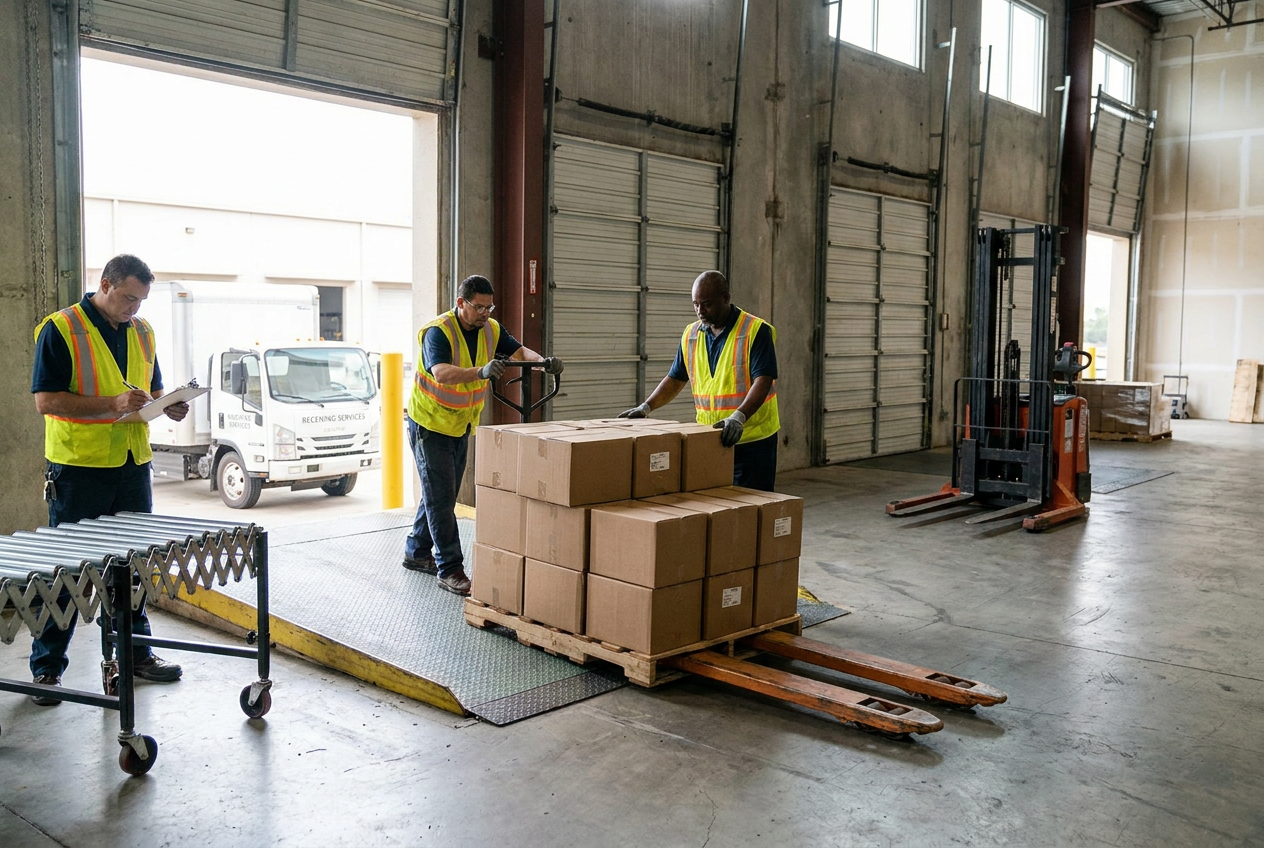
Unloading pallets without a forklift is possible when the trailer, receiving surface, equipment and load are compatible. A pallet jack can move a pallet across a properly equipped loading dock, but it cannot lower one from trailer height to the ground. That distinction should shape your purchasing decision before a truck arrives.
Liquidation is the sale of inventory being cleared from its original sales channel. A reseller buys goods to sell again, often through the secondary market—the channels where surplus and previously sold merchandise are traded. For the broader purchasing picture, start with our liquidation basics and inventory overview; this guide focuses on getting a load off the truck safely.
The practical choices are a compatible dock and pallet jack, appropriately rented equipment, or a third-party receiving facility. Free shipping does not make every address suitable for freight delivery, and an unloading method must be confirmed rather than improvised.
1. Identify the load before choosing equipment
A liquidation pallet is merchandise secured to a pallet base for handling. A truckload is a larger shipment using trailer capacity; confirm whether it is palletized or floor-loaded, meaning cartons or goods are loaded directly onto the trailer floor. A pallet jack cannot unload loose cartons as a unit.
LTL, or less-than-truckload freight, shares trailer space with other shipments. A full trailer may contain substantially more receiving work, even if each pallet is individually manageable. Neither label establishes pallet count, weight or unloading configuration.
Request these details before arranging labor or equipment:
- Pallet count, dimensions and maximum individual loaded weight.
- Load height, overhang and any unusually concentrated or offset weight.
- Pallet entry openings and compatibility with the proposed jack or forks.
- Whether pallets are stacked, damaged, oversized or inaccessible from the trailer rear.
- Whether a manifest is available and what information it actually contains.
A manifest is an inventory list; it is not automatically a verified weight sheet or an unloading diagram. A condition grade describes merchandise condition, not the structural strength of its pallet.
Customer returns have been returned by buyers; overstock is excess inventory; shelf pulls have been removed from selling displays. Salvage can involve damaged, incomplete or nonworking goods. A closeout is inventory cleared as a product line, season or business offering ends. None of these labels alone means new.
Reverse logistics is the movement of goods back from customers or sales channels for evaluation, reuse, resale or disposal. It helps explain why packaging can vary. Review liquidation pallet types and condition distinctions, but use the actual listing and confirmed shipping specifications for your unloading plan.
2. Compare the safe receiving options
| Option | Suitable circumstances | Essential confirmation | Main limitation |
|---|---|---|---|
| --- | --- | --- | --- |
| Manual pallet jack at a dock | Intact, compatible pallets and a nearly level transfer route | Dock equipment rating, trailer restraint and jack capacity | Cannot bridge an unsupported gap or lower freight to ground |
| Powered pallet jack | Dock transfer involving heavier work or longer travel | Trained operator, suitable surface and equipment compatibility | Still requires a safe dock connection |
| Confirmed liftgate arrangement | Ground-level receiving within the gate’s operating limits | Carrier approval, platform dimensions, combined load and operating procedure | Not suitable for every pallet or shipment |
| Rented forklift or other suitable equipment | Site can safely accommodate mechanical unloading | Actual load capacity, reach, surface and qualified operator | Rental alone does not establish a safe plan |
| Third-party receiving facility | Buyer’s address lacks adequate receiving infrastructure | Facility acceptance, capacity and onward handling plan | Adds a separate receiving and storage workflow |
A liftgate is a truck-mounted platform that raises or lowers freight. Do not assume one is included or available for a particular shipment. Confirm the complete unloading arrangement with the order desk before dispatch.
A pallet jack moves freight across a suitable surface; it does not solve the height difference between a trailer and the ground.
3. Use a pallet jack only with a compatible dock
A pallet jack raises a pallet just enough for horizontal movement. At a dock, it needs a safe connection between the trailer floor and building—not simply two surfaces that appear close in height.
A competent receiving operator should verify:
- The trailer is positioned and secured against unexpected movement using appropriate restraint procedures.
- The dock leveler or bridge is designed for the intended equipment, supported and secured correctly.
- Its rated capacity accommodates the load, equipment and people as applicable.
- The trailer floor and receiving route are sound, clear and suitable for the equipment’s wheels.
- Pallet openings, fork length and load weight match the jack’s specifications.
Not every dock plate is suitable for powered equipment. Use equipment according to its manufacturer’s limits and the facility’s procedures. An unhitched trailer also needs the facility’s required support and stability assessment before entry.
Small pallet-jack wheels perform poorly on gravel, soft ground, broken pavement and substantial thresholds. Slopes introduce runaway-load and crushing hazards. Do not substitute plywood, loose boards, improvised ramps or people pushing against the load for a properly engineered transfer route.
4. Rent equipment when the site can support it
If you mean “without owning a forklift,” renting one may be practical. If no forklift can safely operate at your site, a rental does not solve the problem.
Give the rental supplier the maximum pallet weight, dimensions, load height, trailer configuration and surface conditions. Capacity depends on the actual load center and lift height, not only the headline rating. Long, tall or offset loads may require a different machine or an approved attachment.
Confirm adequate turning room, overhead clearance and ground-bearing capacity. Indoor use requires attention to ventilation and equipment suitability. A powered pallet jack or walkie stacker is not automatically a substitute for a forklift unloading a trailer from ground level.
Workplace powered-industrial-truck operators need applicable training, evaluation and authorization. A rental delivery or brief equipment demonstration is not a substitute. Schedule the machine, qualified operator and receiving team together; do not rely on finding a nearby operator after the freight arrives.
Never drag pallets from a trailer with a vehicle, suspend them from unrated attachments, or stand beneath or downhill from a raised load.
5. Choose third-party receiving when your address is unsuitable
A warehouse, cross-dock or receiving service can accept freight at a properly equipped site and hold it for collection or onward transport. A cross-dock transfers goods between inbound and outbound transport with limited storage; not every facility offers inspection, repacking or long-term holding.
Before designating a facility, confirm:
- It accepts outside customers and the specific merchandise involved.
- It can receive the shipment’s trailer type, pallet dimensions and quantity.
- Its appointment process, operating hours and receiving contact are established.
- Staff will record counts, visible damage and seal information where applicable.
- Storage, collection deadlines and any breakdown or repalletizing services are agreed.
- Your onward vehicle and securing method can safely handle the collected goods.
Agree who signs delivery documents, takes photographs and notifies you about exceptions. Do not send freight to a self-storage property or shared industrial address without explicit permission and verified receiving capability.
Separate receiving, rental and storage expenses belong in your operating budget; they do not change PalletCove’s included freight. Our guide to liquidation inventory holding costs explains the storage side. Use mixed-lot inventory cost allocation when distributing those expenses across merchandise after receipt.
6. Know when a site cannot safely accept delivery
An address is not ready merely because a truck can reach it. Stop and revise the receiving plan if any critical requirement remains unresolved:
- No compatible dock, confirmed ground-level transfer method or suitable unloading machine.
- Unknown pallet weights or dimensions that prevent equipment selection.
- Soft, sloped or damaged surfaces along the unloading route.
- Insufficient truck access, turning space, overhead clearance or legal standing space.
- Unstable freight, broken pallets or shifted merchandise requiring specialist handling.
- No qualified operator, responsible receiver or protected pedestrian area.
- No room to stage pallets without blocking exits or vehicle routes.
Hand-unloading is not an automatic fallback. It requires advance approval, safe access, manageable items, adequate staffing and an agreed procedure. Cutting wrap from unstable freight inside a trailer can release merchandise unexpectedly.
If the site fails these checks, arrange an approved receiving facility or a different confirmed plan before dispatch. Do not expect the driver to supply missing equipment or perform unarranged unloading labor.

7. Confirm ordering, price and delivery timing
Browse liquidation pallets for resale, then narrow the receiving requirements using the actual listing. The general merchandise category and truckload inventory category cover different purchasing scales, but category names do not establish pallet dimensions.
For example, the Amazon General Merchandise Truckload listing and Macy’s Textile Truckload listing are separate products to evaluate individually. Do not infer weight, packaging, condition or pallet count from their names. PalletCove is an independent reseller and is not affiliated with, endorsed by or sponsored by any retailer named.
Before payment, confirm the listed purchase unit, actual condition, manifest availability and receiving specifications. “As-is” describes a sale under the stated listing terms; it is not a replacement for reading the applicable claims policy. No listing should be treated as a promise of profit or resale value.
Free shipping is the only delivery option on every order to all 48 contiguous states, and freight is included in the listed price. Buyers researching liquidation pallets in Texas or liquidation pallets in Florida still need an appropriate receiving location.
Handling takes 1–3 business days after payment clears. Transit from Dallas is typically 3–7 business days, for an estimated total of 4–10 business days. The processing cutoff is 2:00 PM Central Time, America/Chicago, Monday–Friday; after-cutoff confirmations begin the next business day. Weekends and applicable holidays do not count.
Use the payment methods shown at checkout: card via a secure payment link, ACH, bank wire and the listed payment apps. Valid resale certificates are reviewed and applied where the buyer’s state allows. Confirm appointment and communication arrangements rather than assuming a universal advance-call window.
8. Inspect delivery and preserve claim evidence
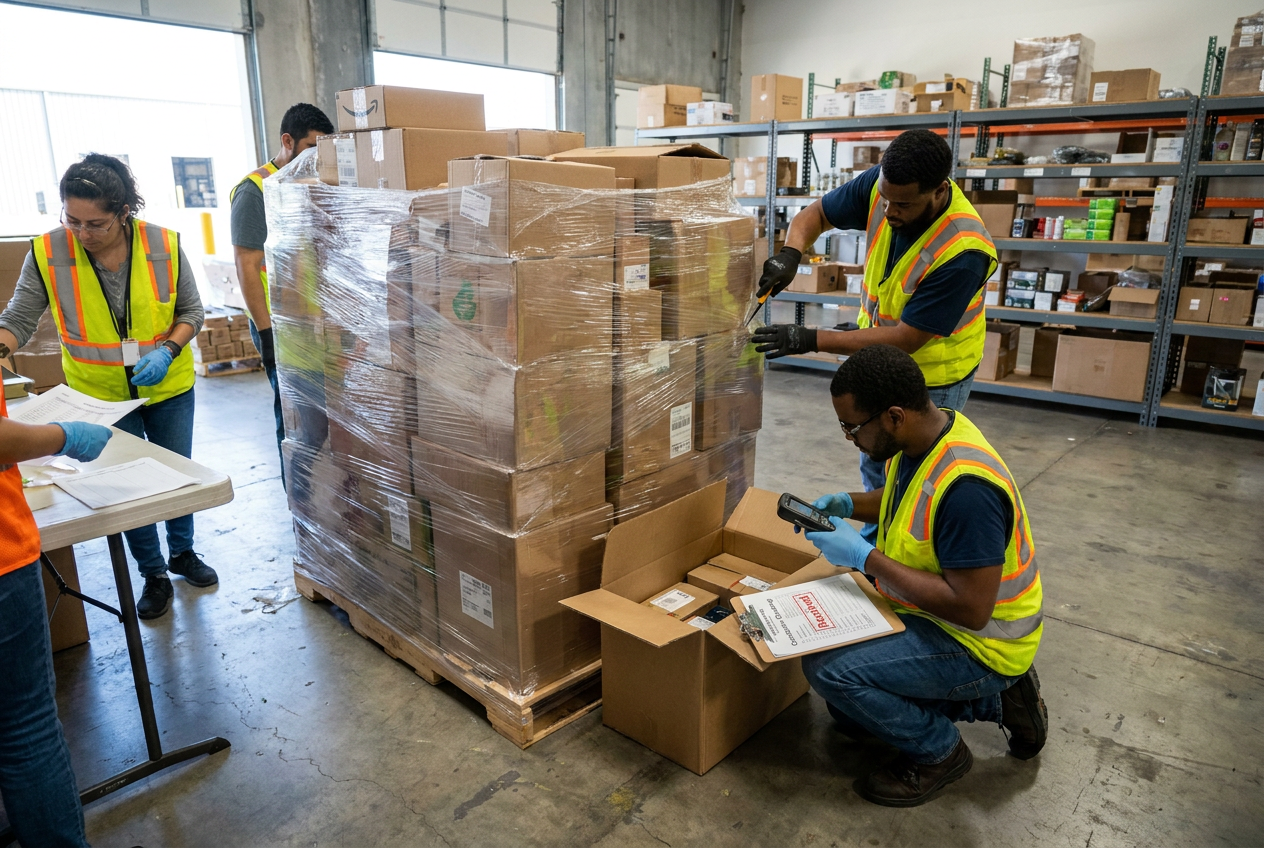
Prepare a clear staging area, receiving documents and a camera before arrival. Compare the shipment identifier and visible pallet count with the delivery paperwork. Photograph accessible wrapping, pallet bases and visible damage before moving goods when safe to do so.
Record specific discrepancies on the delivery receipt and follow the carrier’s exception procedure. Do not open an unstable trailer or cut restraints around shifted freight yourself. Stop unsafe unloading and contact the order desk for instructions; photographs and receipt notes support review but do not guarantee a claim outcome.
PalletCove requests delivery-issue reporting within 48 hours. Preserve packaging, labels and affected merchandise while awaiting instructions. That reporting request does not shorten eligible new-product return rights.
Under the United States Refund & Returns Policy, products explicitly listed as NEW ONLY qualify for defective and non-defective returns and exchanges within 30 calendar days of delivery. Returns are by mail; the customer is responsible for the return label and shipping, and a 15% restocking fee applies to the product price. Refund processing takes 10 calendar days after authorized return receipt and inspection, or approval where no physical return is required.
Mixed and used loads have separate claims terms, not routine change-of-mind returns. Overstock, shelf-pull, customer-return and salvage labels do not establish NEW ONLY eligibility.
Frequently asked questions
Can a pallet jack unload a truck without a dock?
Not by itself: it cannot lower a pallet from trailer height. Ground-level receiving needs a confirmed compatible transfer method, such as an appropriate liftgate arrangement or suitable unloading equipment.
Is liftgate delivery guaranteed with free shipping?
No liftgate capability should be assumed. Free shipping is the only delivery option and freight is included, but the unloading arrangement must be confirmed for the particular shipment and site.
Can I unload a pallet by removing boxes individually?
Only under an agreed, safe hand-unloading plan suited to the goods and trailer. Heavy items, unstable stacks or inaccessible cartons can make that approach unsafe or impractical.
Can a residential driveway receive a liquidation truckload?
Only if truck access, standing space, unloading equipment, surface conditions and local restrictions all permit it. Many residential sites lack those capabilities; third-party receiving is often the more workable alternative.
What if the pallet arrives damaged or heavier than expected?
Stop if the equipment rating or pallet stability is in doubt. Document what is safely visible and contact the order desk rather than attempting an improvised lift or transfer.
Talk to PalletCove Liquidation
Choose the receiving method before ordering, not at the trailer door. Use our complete liquidation overview for broader buying guidance, then contact our order desk with your site details and the current inventory you are considering.
PalletCove Liquidation LLC
4820 Cove Industrial Blvd, Dallas, TX 75236
Phone: (713) 819-3904
Email: sales@palletcoveliquidation.com
Hours: Mon–Fri 8:00 AM – 6:00 PM CT, Sat 9:00 AM – 2:00 PM CT, Sun closed