

Buying liquidation pallets with friends can spread the purchase cost and workload, but a handshake leaves important questions unanswered. Who owns the best items? Who absorbs a shortage? What happens when one person wants their money back before anything sells? Write those answers down before anyone pays.
A liquidation pallet is a palletized lot of merchandise offered for resale, potentially including excess inventory, returns or other listed conditions. For the broader purchasing process, use our guide to buying liquidation pallets. This article focuses on the agreement between co-buyers—not a promise that sharing a purchase reduces merchandise risk.
Your agreement should identify the exact lot, contributions, ownership method, receiving duties and exit rules. It governs your arrangement with friends; it does not change PalletCove’s listing, payment requirements or returns and claims terms.
1. Agree on the purchase before pooling money
A pallet listing is the seller’s description of a specific offer, including its price, quantity information, merchandise description and stated condition. Save a dated copy and have every participant approve it. A replacement lot requires fresh approval, even if the price is similar.
Record these details:
- Unit count: the number of individual items represented in the offer; distinguish an exact count from an estimate.
- Category mix: the distribution of merchandise types within the lot, such as household goods or apparel.
- Manifest: an inventory document describing the lot’s contents, sometimes with quantities or other item information. Record whether one is available and what the listing says about its accuracy.
- Condition grade: the seller’s stated condition classification. Do not assume grading language means the same thing across suppliers.
Overstock describes excess stock; shelf pulls describe merchandise removed from selling shelves. Neither label alone establishes that everything is new. Customer returns may have missing components or functional problems, while salvage may require repair, parts recovery or disposal. An as-is description should be read alongside the actual listing and applicable policy, not treated as a universal statement about return eligibility.
Compare general merchandise lots with truckload inventory based on the group’s handling capacity. A truckload is a larger purchase moving as a full trailer rather than a single pallet; LTL means less-than-truckload freight, where smaller shipments share trailer space. These terms describe scale and transport, not quality.
For concrete listing comparisons, review the Amazon General Merchandise Truckload and Shoes Truckload only if those merchandise types fit your plan. Confirm current contents, availability and condition rather than inferring them from a product name. PalletCove is an independent reseller and is not affiliated with, endorsed by or sponsored by any retailer named.
2. Put ownership and spending authority in writing
Choose one of two structures: divide merchandise after inspection, or keep it jointly owned and distribute net proceeds. Avoid drifting between them. Someone who receives their allocated inventory should not automatically owe the group a share of their later sales unless the agreement expressly requires it.
Use this framework as a practical starting point, not individualized legal advice. Significant or ongoing joint operations merit professional review.
| Agreement field | What to write down |
|---|---|
| --- | --- |
| Participants | Names, contact information and signatures |
| Approved purchase | Listing identifier, date, description and maximum total |
| Contributions | Dollar amount, due date and ownership percentage |
| Buyer of record | Who places the order and communicates with the supplier |
| Spending authority | Who can approve expenses and the approval threshold |
| Ownership model | Physical inventory split or pooled resale proceeds |
| Division method | Allocation rules, inspection deadline and tie-breaker |
| Loss allocation | Treatment of shortages, damage and unusable items |
| Logistics | Receiving address, unloading, storage and collection duties |
| Exit procedure | Buyouts, unsold inventory, deadlines and dispute steps |
The buyer of record should retain the invoice and share order updates. Being the order contact does not, by itself, resolve ownership between friends; your written agreement should.
Specify voting rules too. Routine expenses might need majority approval, while a different lot, extra contribution or change in ownership percentages should require everyone’s written consent.
The safest time to agree on who gets damaged or slow-selling inventory is before anyone knows which items they want.

3. Set payment deadlines and a complete shared budget
PalletCove’s listed price includes freight. Free shipping is the only delivery option on every order to all 48 contiguous states. Do not add a second supplier-freight allowance to the group’s budget.
Separate the purchase amount from your own operating costs: storage, packing materials, local movement after delivery, marketplace charges and approved disposal expenses. Set a reserve if needed, identify who holds it and explain when unused money will be returned.
For example, if an agreed purchase amount is $2,400 and three friends contribute $800 each, each has a one-third interest under an equal-share agreement. A separately approved $300 operating reserve would require another $100 each. These numbers illustrate accounting only; they are not a listing price or earnings forecast.
Check the payment policy and use the methods shown at checkout: card via a secure payment link, ACH, bank wire and the listed payment apps. Internal contributions between friends are separate from payment to PalletCove. Do not assume the supplier can split one order across your group.
Write a contribution deadline and a default rule: if someone misses it, pause the order or obtain written approval for revised shares. Never quietly turn another person’s shortfall into your loan. Valid resale certificates are reviewed and applied where the buyer’s state allows.
Keep first-purchase checks and order verification in your workflow; the complete pallet-buying walkthrough covers those steps without replacing your shared agreement.
4. Divide inventory by a method everyone can audit
Equal unit counts rarely guarantee an equitable split. One participant could receive bulky, incomplete goods while another receives compact, complete items. Choose a method before opening the lot.
Physical division after inspection
Inspection means documenting and examining received merchandise to understand its count, visible condition and completeness, with functional checks where safe and appropriate. It is your receiving process, not a promise of supplier item-level testing.
Create a shared inventory sheet with item identifiers, quantities, observed condition, missing parts and photographs. Then allocate using one method:
- Balanced bundles: Build groups with comparable category and condition profiles, then assign them by an agreed draw.
- Rotating selection: Draw the first picking order, reverse it in the next round and repeat. Inspect before selecting.
- Internal allocation values: Agree on bookkeeping values, then assign inventory until each participant reaches their ownership share.
Internal values are negotiation tools, not guaranteed resale values. Set a tie-breaker for disagreements, such as another participant’s review or moving the disputed item into pooled inventory. Settle any agreed balancing payment before removing goods.
Joint ownership until sale
For pooled inventory, record every sale, approved expense, refund and payout. Define net proceeds as actual receipts minus the specific expenses everyone approved. Agree whether labor earns a fixed payment, an hourly payment or no separate compensation.
Prohibit undocumented personal withdrawals. Reconcile the ledger regularly, and retain an agreed reserve for unresolved customer transactions before final distribution.
5. Assign delivery, unloading and storage responsibilities
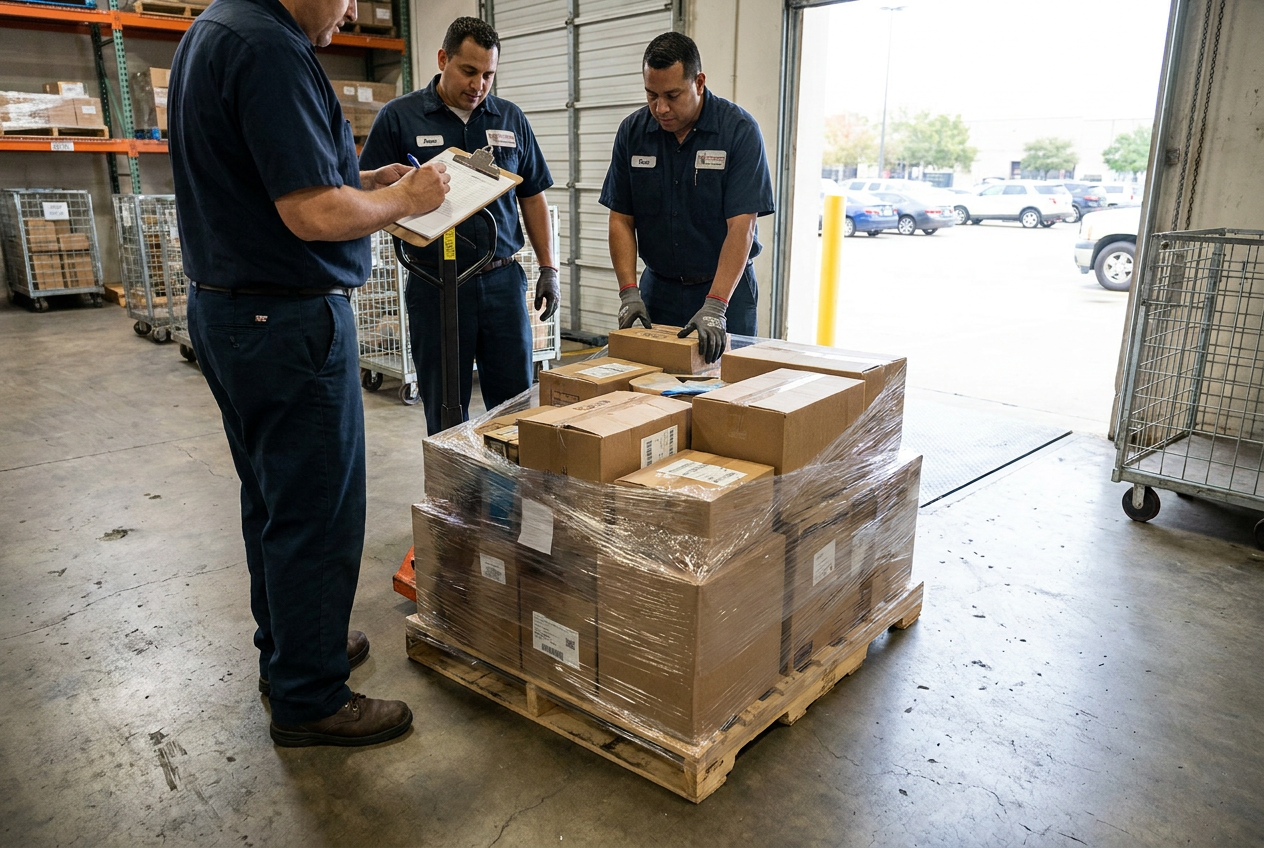
Choose one receiving address before ordering. Name the person responsible for coordinating receipt, confirming site access and arranging suitable unloading equipment and help. Do not assume the delivery driver will divide the lot or that every address can receive every load.
Handling takes 1–3 business days after payment clears. Transit is typically 3–7 business days from Dallas, for an estimated 4–10 business days total. The processing cutoff is 2:00 PM Central Time, Monday–Friday; after-cutoff confirmations begin the next business day. Weekends and applicable holidays do not count.
For groups comparing liquidation pallets in Texas and liquidation pallets in Florida, the free-shipping rule is the same. Use the liquidation pallets hub to orient your search, then confirm the specific listing and receiving requirements.
If considering a full trailer, consult the truckload buying guide before committing the group to that scale.
Your agreement should specify:
- Who receives and signs for the shipment.
- Who supplies equipment and coordinates safe unloading.
- Who documents arrival condition and starts the inventory record.
- Where merchandise stays and who can access it.
- Who handles local transport after division.
- Collection deadlines and any agreed storage reimbursement.
Measure usable space before purchasing. The liquidation inventory storage guide covers space planning; your agreement should assign responsibility for that space rather than assume a friend’s garage remains available indefinitely.
6. Separate shared losses from supplier claims
On delivery day, photograph the shipment before disturbing packaging where practical. Document visible damage, packaging problems and apparent shortages; note exceptions on delivery paperwork where possible. Keep labels, packaging and relevant records while an issue is being reviewed.
Request delivery-issue reporting within 48 hours so evidence can be assessed promptly. That reporting request does not shorten eligible new-product 30-day returns.
Under the United States Refund & Returns Policy, products explicitly listed as NEW ONLY qualify for defective and non-defective returns and exchanges within 30 calendar days of delivery. Returns are by mail; the customer is responsible for the return label and shipping, and a restocking fee of 15% of the product price applies. Refund processing takes 10 calendar days after authorized return receipt and inspection, or approval where no physical return is required. Mixed and used loads have separate claims terms, not routine change-of-mind returns.
Designate one person to submit supplier communications. Do not dispose of disputed merchandise or make unsupported promises to the other participants while authorization or review is pending.
Internally, allocate ordinary lot-condition losses using the agreed ownership percentages or allocation method. Distinguish those from damage caused later by a participant’s handling or storage. Decide in advance what evidence is required and how responsibility will be resolved.
If the group receives a supplier refund or adjustment, credit it to the affected shared expense or inventory allocation—not automatically to whoever received the payment.
7. Decide what happens to unsold stock and disagreements
Set review dates, such as 30, 60 and 90 days after inventory becomes available for sale. These are internal planning dates, not supplier return deadlines. Agree who may reduce prices, bundle goods or move inventory to a different sales channel.
For jointly owned stock, establish an exit sequence:
- Reconcile sales, expenses, cash and remaining inventory.
- Offer participants a buyout using a written valuation method.
- If nobody accepts, use an approved bulk-sale or further-markdown plan.
- Document any agreed donation, recycling or disposal.
- Allocate remaining cash and approved losses, then sign the closing ledger.
Avoid requiring an exiting participant to receive their original contribution regardless of outcomes. That shifts the inventory risk onto everyone else. A buyout should follow the agreed method and available evidence, not an assumed profit.
Common mistakes include letting the fastest picker take desirable goods, compensating storage labor only after resentment develops, and distributing all cash before outstanding expenses are settled. Require written amendments and use a staged dispute process: review records, meet by a deadline, then seek a mutually agreed neutral mediator if necessary.
Frequently asked questions
Can friends each pay PalletCove for part of one pallet?
Do not assume split payment is available. Confirm checkout arrangements before collecting contributions, and identify the buyer of record in your agreement.
Is an equal item split fair?
Not necessarily, because condition, completeness and handling requirements differ. Use inspected bundles, rotating selections or agreed internal allocation values rather than unit count alone.
Who gets a refund if the order has a problem?
Supplier communications and any authorized adjustment follow the order and applicable policy. Your agreement should require the buyer of record to document the outcome and allocate the adjustment to the participants entitled to it.
What if a friend stops helping after delivery?
Use predefined duties, deadlines and replacement-labor approval rules. Do not retroactively reduce their ownership share unless your agreement permits that action and its process is followed.
Can we return goods simply because they do not sell?
Unsold inventory does not create a separate return entitlement. Eligibility depends on the actual listed condition and applicable policy; plan markdowns and exits before buying rather than relying on returns.
Talk to PalletCove Liquidation
Before pooling funds, finish your written agreement and review the buying liquidation pallets guide for the broader purchase process. Then compare current inventory and contact our order desk with questions about a specific listing or receiving requirements.
PalletCove Liquidation LLC is located at 4820 Cove Industrial Blvd, Dallas, TX 75236. Phone: (713) 819-3904. Email: sales@palletcoveliquidation.com. Hours: Mon–Fri 8:00 AM – 6:00 PM CT, Sat 9:00 AM – 2:00 PM CT, Sun closed.