
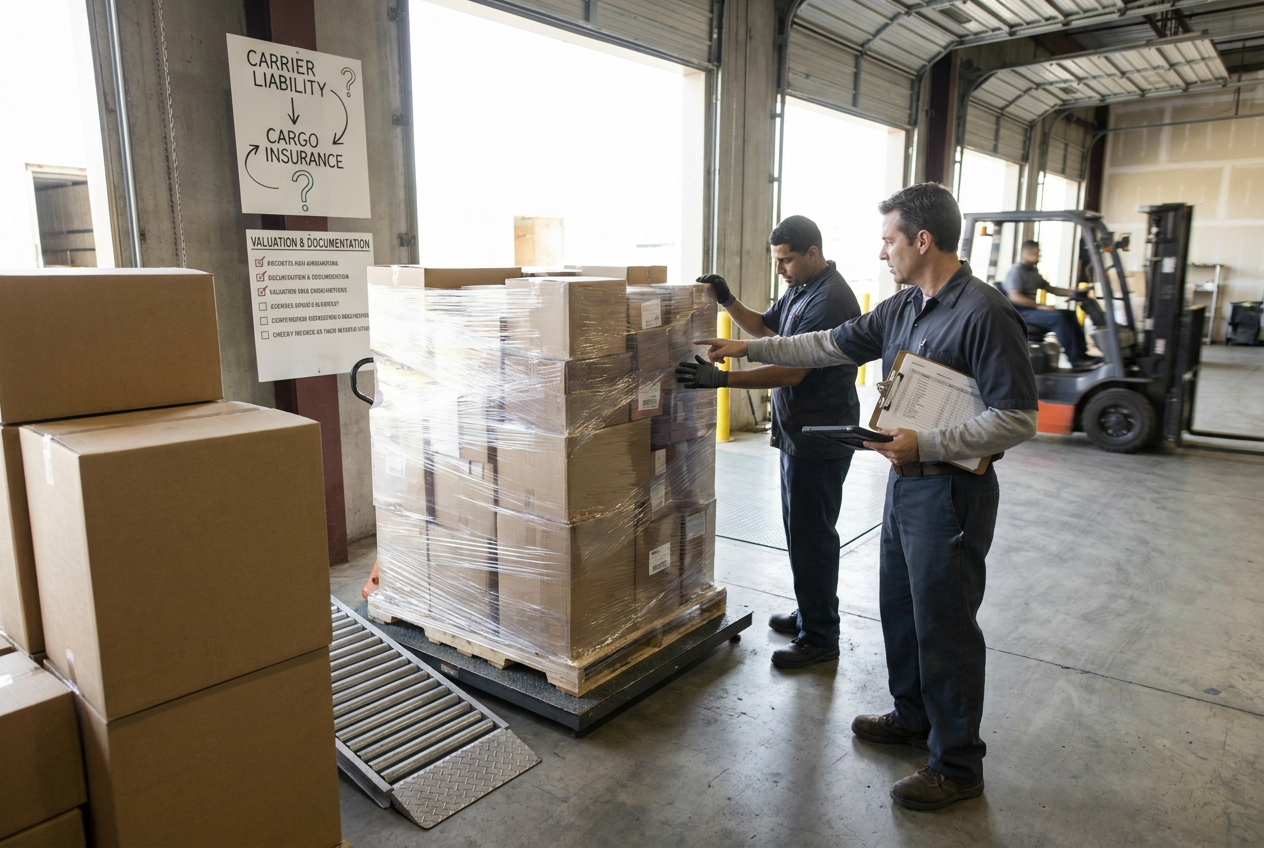
Cargo insurance for liquidation freight deserves attention before pickup—not after a damaged pallet arrives. A shipment can have carrier liability protection without giving the buyer insurance that reimburses the full purchase price. Even when cargo insurance applies, exclusions and valuation provisions can leave important gaps.
For the broader purchasing process, start with our guide to buying liquidation truckloads. This article focuses on the coverage questions independent resellers should settle before shipping: whose policy responds, what merchandise qualifies, how loss is valued and what evidence a claim requires.
PalletCove includes freight in the listed price, but included delivery does not itself establish insurance coverage. Ask for written confirmation of any protection represented as applying to your particular shipment.
Carrier liability is not the same as cargo insurance
Carrier liability is a transportation provider’s legal responsibility for qualifying loss or damage while goods are in its custody. It is not an unconditional promise to replace everything damaged in transit. Applicable law, shipping contracts, liability limits, defenses and the evidence of the shipment’s original condition can affect recovery.
Cargo insurance is a policy covering specified interests in goods against covered transit risks. A shipper’s-interest policy can protect the owner’s interest in the merchandise, while a carrier’s motor truck cargo policy generally protects the carrier’s liability exposure under its terms. A carrier having insurance does not automatically make the buyer an insured party.
| Coverage question | Carrier liability | Cargo insurance |
|---|---|---|
| --- | --- | --- |
| What creates the obligation? | Applicable law and transportation contract | Policy wording and endorsements |
| Must carrier responsibility be established? | Generally, subject to the governing legal framework | Depends on the type of policy |
| What limits recovery? | Liability limits, defenses and proven loss | Valuation, deductibles, limits and exclusions |
| Does an invoice guarantee full reimbursement? | No | No; it supports value but does not override policy terms |
| Who can submit a claim? | A party entitled under the shipment arrangements | The insured or another authorized party under the policy |
A bill of lading is the transportation document that identifies the shipment, parties and relevant carriage terms and serves as a receipt when freight is accepted. It is not an insurance policy. Likewise, declaring a value on shipping paperwork does not necessarily purchase insurance or override a carrier’s liability limit.
Free shipping describes how delivery is priced. It does not describe the scope, beneficiary or payout limit of insurance.
Identify the shipment and its actual condition
A liquidation pallet is merchandise consolidated on a pallet for bulk sale. A truckload is a bulk shipment arranged at truckload scale; a full trailer uses the trailer for that shipment, though it does not necessarily occupy every cubic foot or reach maximum legal weight. LTL means less-than-truckload service, where freight shares a transportation network with other shipments.
Full truckload versus partial-load arrangements matter because custody changes, transfers and temporary storage can affect coverage. LTL may involve more terminal handling than a direct full-trailer movement. Confirm the actual routing rather than assuming the purchase name determines the transportation method.
Compare truckload inventory and general merchandise lots by what their listings disclose. A condition grade is the seller’s description of merchandise condition, not a universal insurance classification:
- Overstock generally describes excess inventory; it does not independently establish new condition.
- Shelf pulls have been removed from retail display or sale and may have handling or packaging wear.
- Customer returns can contain a range of conditions and missing components.
- Salvage may include damaged, incomplete or nonworking merchandise.
- As-is describes the sale basis; it does not, by itself, determine whether a separate transit policy covers a new shipping loss.
For listings such as the Amazon General Merchandise Truckload or Macy’s Textile Truckload, submit the actual description and available manifest to the insurer. Do not infer condition from a product name. PalletCove is an independent reseller and is not affiliated with, endorsed by or sponsored by any retailer named.
Verify exclusions before authorizing shipment
Ask the insurer or authorized coverage provider to confirm in writing that the actual merchandise condition is accepted. Broad language such as “all risk” still comes with exclusions, conditions and limits.

Verify these potential gaps:
- Used, returned or salvage goods: Some policies restrict eligible merchandise or cover only named causes of loss.
- Pre-existing damage: Transit protection generally is not a warranty against defects already present before shipment.
- Mechanical or electrical derangement: An item that fails to operate without evidence of external transit damage may fall outside coverage.
- Insufficient packaging: Loose cartons, inadequate blocking or unsuitable pallet construction can create coverage disputes.
- Moisture and inherent deterioration: Condensation, mold, rust or the goods’ own characteristics may be treated differently from an accidental covered water event.
- Shortage and unexplained disappearance: Missing contents inside intact packaging can require different proof than a missing pallet.
- Theft conditions: Unattended vehicles, parking locations, security requirements or certain commodities may have special restrictions.
- Delay and business losses: Lost selling opportunities and expected resale profit commonly fall outside physical-loss coverage.
Also check whether coverage includes loading, unloading, subcontracted carriers, terminal transfers and temporary storage. Ask exactly when protection attaches and ends. A policy that ends at delivery may not protect inventory stored afterward in your facility.
Understand valuation, deductibles and shipment limits
Liquidation insurance claims depend on the agreed valuation basis—not a hoped-for selling price. A manifest, meaning an inventory list supplied for a lot, can support identification and quantity. Its retail-value column does not automatically establish insured value, and its accuracy or completeness should be checked against the listing’s qualifications.
Ask whether settlement uses invoice cost, actual cash value, agreed value or another formula. Then verify:
- Whether the insured amount matches the qualifying purchase value.
- Whether a deductible applies per shipment, occurrence, pallet or another unit.
- Whether commodity sublimits reduce the headline policy limit.
- How depreciation, pre-existing damage and recoverable salvage affect payment.
- Whether underinsurance or coinsurance provisions can reduce recovery.
- How value is allocated when only part of a mixed lot is damaged.
For example, a $12,000 lot does not necessarily support a $12,000 claim when only several cartons sustain covered damage. The adjuster may need a defensible allocation of purchase cost to those cartons. Conversely, a policy with a $10,000 applicable shipment limit cannot be assumed to protect the entire $12,000 purchase before any deductible or other adjustment.
Because freight is included in PalletCove’s listed price, ask what invoice documentation the insurer needs. Do not invent a separate transportation amount or insure a manifest’s suggested retail total without written agreement on valuation.
Put coverage verification into the ordering process
Use liquidation truckloads for sale to compare larger lots and the liquidation pallets hub for pallet-level options. Before paying, retain the listing, condition description, available manifest and order terms. Confirm who arranges any insurance, who is insured, who receives payment after an approved claim and who must file it.
A certificate of insurance is evidence of insurance information, not the complete coverage contract. Request the relevant policy wording, exclusions, endorsements, deductible and shipment-specific confirmation where applicable. Resolve uncertainties before the goods enter transit; do not assume protection can be added retroactively.
Payment methods are those shown at checkout: card via a secure payment link, ACH, bank wire and the listed payment apps. Valid resale certificates are reviewed and applied where the buyer’s state allows.
Free shipping is the only delivery option on every order to all 48 contiguous states, and freight is included in the listed price. That applies to buyers sourcing liquidation pallets in Texas and liquidation pallets in Florida, as well as the other contiguous states.
Under the shipping policy, handling takes 1–3 business days after payment clears. Transit from Dallas is typically 3–7 business days, for an estimated total of 4–10 business days. The processing cutoff is 2:00 PM Central Time, America/Chicago, Monday–Friday; confirmations after cutoff begin processing the next business day. Weekends and applicable holidays do not count. Match the coverage period to the actual shipment rather than treating estimated dates as guaranteed.
Build the evidence file before delivery
Transit claims often turn on whether the evidence distinguishes shipping damage from the merchandise’s original condition. Obtain available origin photographs and pallet counts before dispatch. Record packaging condition, labels and any trailer seal information available without assuming every shipment uses a seal.
Plan receiving access and equipment in advance. A loading dock is a raised platform used to transfer freight between a trailer and a building. Trailer capacity, dock setup and delivery appointments are separate planning subjects; the receiving a liquidation truckload checklist covers the operational preparation without replacing insurance instructions.
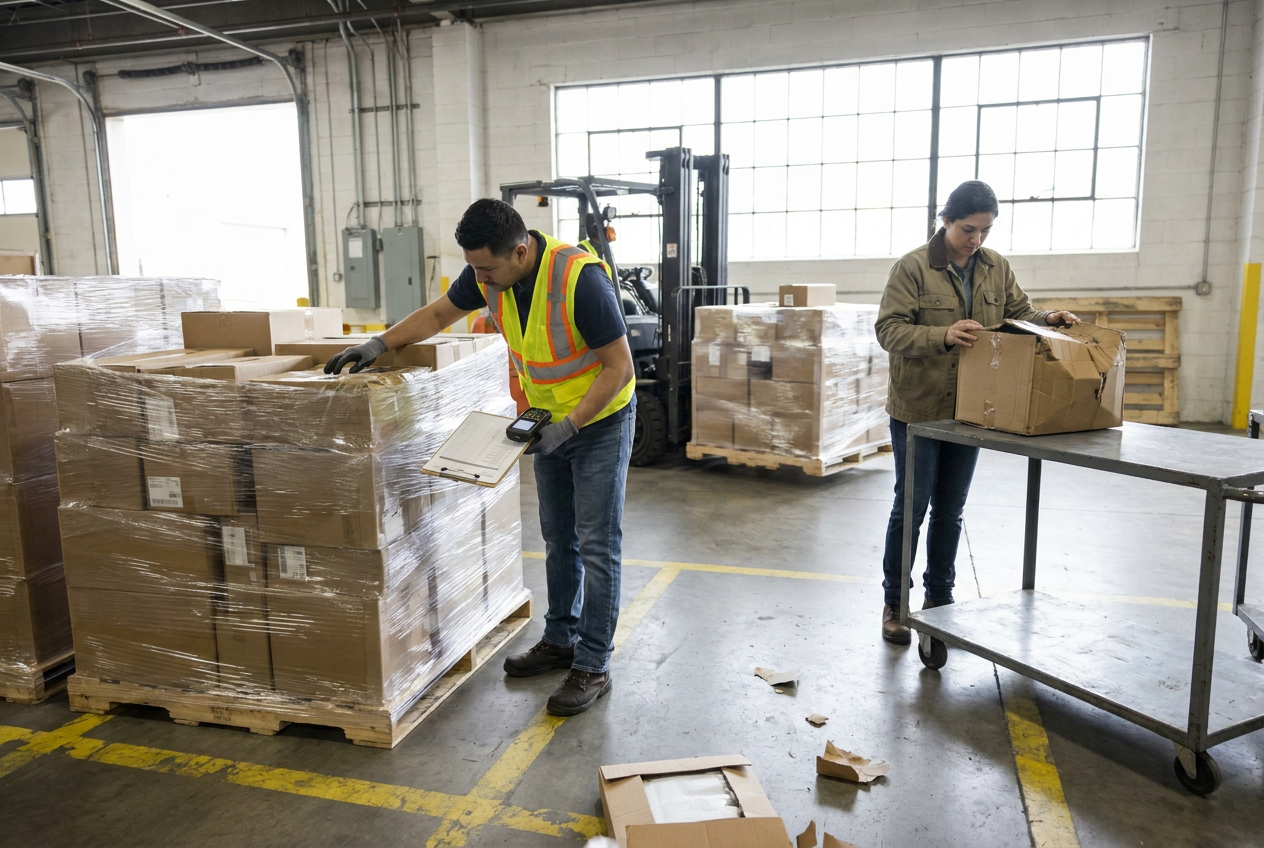
On delivery:
- Compare shipment identifiers and pallet or handling-unit counts with the bill of lading.
- Photograph the accessible load and packaging before disturbing them, then document damage during unloading.
- Note specific visible damage or shortages on the delivery receipt before signing when possible; keep a copy.
- Open suspect packages promptly and preserve labels, wrap, cartons and damaged goods.
- Separate affected stock from saleable inventory and take reasonable steps to prevent further damage safely.
A clean receipt can complicate a concealed-damage claim, but it does not necessarily defeat every claim. Follow the liquidation pallet inspection guide for a fuller delivery-to-inventory workflow. After receiving, keep affected merchandise identifiable in storage and obtain instructions before disposal, repair or sale.
Keep freight claims separate from returns
Report delivery issues to PalletCove within 48 hours and promptly notify the responsible carrier or insurer as required. This reporting request is not a substitute for a formal claim and does not shorten eligible new-product return rights. Ask for the applicable notice requirements and claim-filing deadlines; do not assume a phone call or delivery notation completes the process.
A useful claim packet includes:
- Invoice, payment evidence, listing and condition description.
- Available manifest and an explanation of claimed quantities.
- Bill of lading, delivery receipt and shipment identifiers.
- Origin and destination photographs, including packaging.
- A timeline of discovery, handling and notification.
- An itemized loss calculation and any requested inspection or repair evidence.
Common mistakes include claiming pre-existing defects as transit damage, relying on retail estimates, discarding packaging and accepting a settlement without understanding any release. Coordinate overlapping seller, carrier and insurer processes; the same loss cannot be recovered twice.
Under the United States Refund & Returns Policy, products explicitly listed as NEW ONLY qualify for defective and non-defective returns and exchanges within 30 calendar days of delivery. Returns are by mail, with the customer responsible for the return label and shipping. A restocking fee of 15% of the product price applies; refund processing takes 10 calendar days after authorized return receipt and inspection, or approval where no physical return is required. Mixed and used loads have separate claims terms, not routine change-of-mind returns.
Frequently asked questions
Does free shipping mean the shipment is fully insured?
No. Free shipping means freight is included in the listed price. Coverage, insured parties, exclusions and settlement limits require separate written verification.
Can customer returns and salvage be insured?
Some policies accept these goods, sometimes with restricted coverage. Disclose their actual listed condition and obtain confirmation before shipping; protection against transit damage is not protection against existing defects.
Is a manifest enough to prove the claim value?
Usually not by itself. Pair it with the invoice, listing, photographs and a supportable allocation of purchase cost to the affected merchandise. The policy’s valuation provision controls settlement.
What if damage appears only after unwrapping?
Photograph the discovery, preserve packaging and record when and how the damage became visible. Report it promptly and follow concealed-damage procedures; acceptance depends on the evidence and applicable terms.
Should damaged merchandise be refused automatically?
No single response fits every shipment. Document the condition and seek prompt instructions from the seller, carrier and insurer when feasible, while prioritizing safety. Refusal alone does not guarantee a refund or establish a covered claim.
Talk to PalletCove Liquidation
Before shipping, verify merchandise eligibility, valuation, exclusions, coverage dates and claim responsibilities in writing. For the broader load-selection and logistics process, return to our liquidation truckload buying guide.
PalletCove Liquidation LLC is located at 4820 Cove Industrial Blvd, Dallas, TX 75236. Call (713) 819-3904 or email sales@palletcoveliquidation.com. Hours: Mon–Fri 8:00 AM – 6:00 PM CT, Sat 9:00 AM – 2:00 PM CT, Sun closed.
For listing details and shipment-document questions, contact our order desk, or review current inventory before selecting your next lot.