
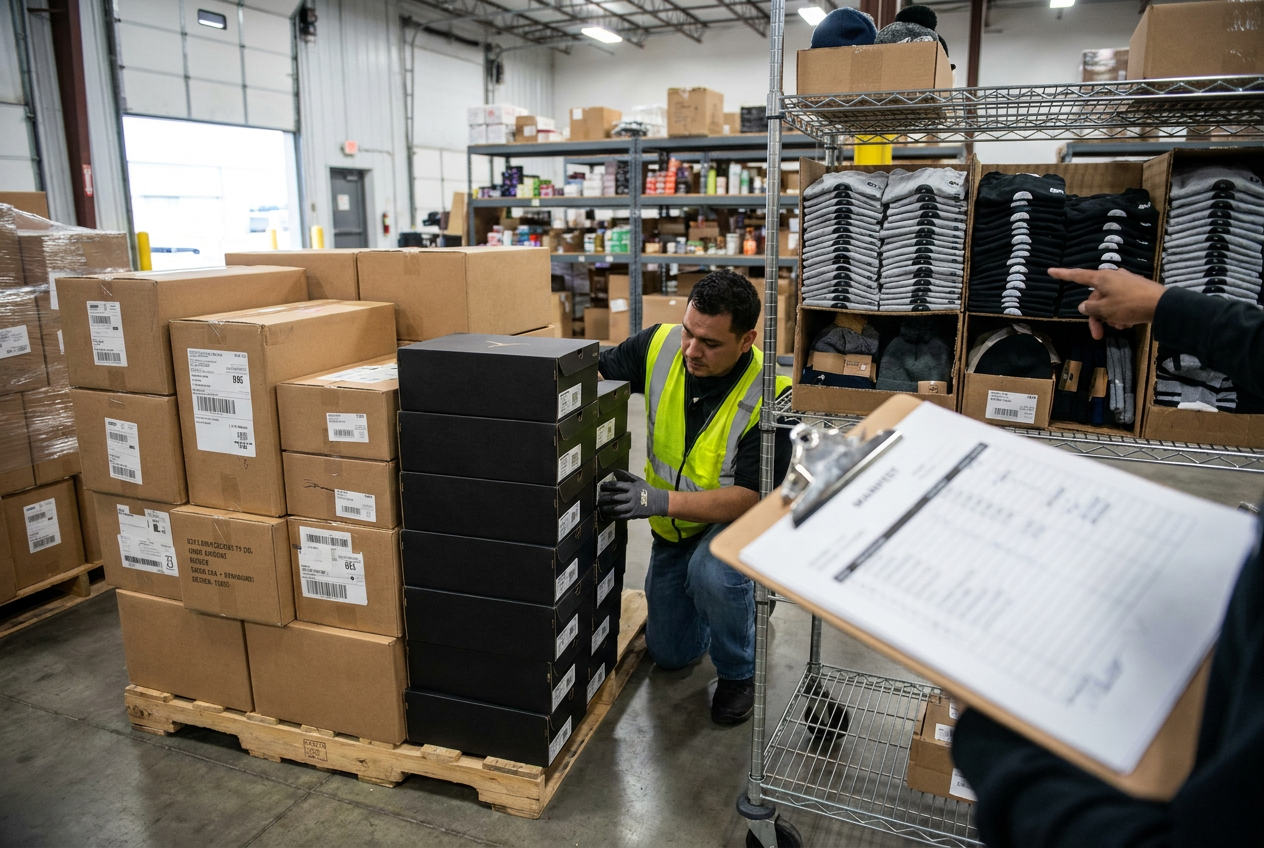
A load can contain hundreds of units yet depend on one narrow group of customers. Repeated SKUs, apparel concentrated in a few sizes and footwear arriving near the end of its selling season can leave a reseller with plenty of stock but few realistic selling opportunities.
Liquidation inventory concentration risk is the exposure created when too much purchasing capital depends on the same product, buyer segment, season or sales channel. For the broader purchasing process, start with our guide to buying liquidation pallets. Here, the focus is deciding how much overlapping inventory your business can reasonably absorb.
The objective is not to eliminate duplicates. Repetition can simplify photography, listings and fulfillment. The objective is to distinguish useful replenishment from an oversized position that ties up cash, storage and selling time.
What concentration means inside a liquidation load
A liquidation pallet is a palletized lot of merchandise sold in bulk through a liquidation channel. A pallet listing is the seller’s description of the lot offered, including its stated contents, condition, quantity and purchase terms. Unit count means the number of individual merchandise units represented in that offer—not the number of distinct products or customers it can serve.
Category mix describes how the inventory is distributed across merchandise categories. A broad category mix can reduce dependence on one type of demand, but only if those categories actually have different buyers and selling patterns.
Consider three layers of concentration:
- Exact-item concentration: Many units share one SKU, meaning the same stock-keeping identifier for a particular product or variant.
- Demand concentration: Different SKUs still compete for the same customer, such as similar tops in the same size.
- Timing concentration: Otherwise different items need to sell during the same short seasonal window.
A large unit count measures inventory volume; it does not establish demand diversity.
A full truckload can repeat the same assortment across many pallets. Conversely, a smaller lot can contain a useful spread of products. Our guide to buying liquidation truckloads covers the broader scale decision; concentration analysis determines whether that scale suits your demand.
Read the manifest for overlapping demand
A manifest is an inventory document describing a lot’s contents, sometimes including quantities, identifiers, sizes and condition information. Its detail varies. Ask whether it applies to the specific offered load, whether quantities are estimated and whether photographs are representative or lot-specific.
Group manifest lines before evaluating the total. Separate line entries do not necessarily represent separate demand: the same shoe may appear under several descriptions, while different colors may still appeal to substantially the same audience.
| Check | Calculation or review | What it reveals |
|---|---|---|
| --- | --- | --- |
| Largest SKU share | Largest SKU quantity divided by total units | Dependence on one exact item |
| Top-five SKU share | Combined quantity of five largest SKUs divided by total units | Whether a few items dominate |
| Size concentration | Units in each size divided by relevant apparel or footwear units | Exposure to a narrow customer fit |
| Seasonal share | Units needing the same selling window divided by total units | Deadline pressure |
| Weeks of supply | Existing units plus incoming units, divided by observed weekly sales | Likely inventory duration |
These are screening measures, not universal buying thresholds. A concentrated SKU may be sensible when you have demonstrated demand; a seemingly diversified lot may be unsuitable when none of its categories fit your channels.
If no detailed manifest exists, request available size breakdowns, repeat-item information and lot-specific photos. Missing information is uncertainty—not evidence of a balanced assortment. Reduce your commitment or pass when the unknowns exceed your tolerance.

Examine duplicates, apparel sizes and seasonal footwear separately
Duplicate SKUs need a replenishment case
Repeated products are easiest to justify when your own records show regular completed sales at a sustainable pace. Do not substitute active marketplace listings or an advertised retail price for evidence of demand.
Suppose you already own 30 units, are considering 90 more and have averaged six completed sales weekly. The combined position represents 20 weeks of supply if that pace continues. This hypothetical calculation excludes returns, cancellations and changing demand; use a slower-sales scenario as well.
Ask whether variants substitute for one another. Adding another color may expand selection without expanding total demand. Selling through several channels also does not guarantee independent audiences.
Apparel needs usable size runs
A size run is the assortment of sizes available within a style. A lot containing many styles but mostly one size remains exposed to a narrow fit segment. Equally distributed sizes are not automatically ideal either: your own customer demand determines the appropriate balance.
Review size alongside style, garment type, measurements where available and intended season. Do not infer clothing content or balanced sizes from a broad textile label. When reviewing the Macy’s Textile Truckload listing, verify its actual listed contents before treating it as an apparel opportunity.
Footwear combines size and calendar risk
Seasonal footwear can be concentrated by style, size and timing simultaneously. Different boot designs may still depend on the same weather window. Count pairs as offered in the listing, and clarify whether a stated unit refers to a pair or something else.
Use the Shoes Truckload listing to check the current offered details, not as evidence that every load has the same size distribution. If size or seasonal information is absent, request clarification before purchasing.
Include time for receiving, sorting, photographing and listing. Inventory delivered during a selling season may not become available to customers until much later.
Compare load types and condition without assuming diversity
Category-level loads provide a focused assortment, but specialization can amplify concentration. Compare the general merchandise category with the truckload category based on actual contents rather than category names alone.
A mixed general-merchandise load may spread demand while increasing sorting and listing work. A category-specific pallet may be easier to process but heavily weighted toward repeat styles. Multiple pallets can share the same underlying assortment, and a full trailer can multiply that exposure. LTL, or less-than-truckload transportation, and full-trailer movement describe transport scale—not assortment quality.
A condition grade is the seller’s stated classification of merchandise condition. Read its definition in the individual listing; grading terminology is not necessarily interchangeable between suppliers.
- Overstock: Excess inventory; the term alone does not verify that every item is new or undamaged.
- Shelf pulls: Merchandise removed from selling shelves, potentially with handling or packaging wear.
- Customer returns: Previously returned merchandise whose condition must be evaluated under the offered description.
- Salvage: Merchandise offered with substantial limitations that may suit parts, repair or recovery rather than ordinary resale.
“As-is” describes a stated sale basis, not an item-level test result. Do not assume testing, completeness or a guaranteed usable quantity. A concentrated load with uncertain condition combines demand risk with processing and recovery uncertainty.
PalletCove is an independent reseller and is not affiliated with, endorsed by or sponsored by any retailer named.
Set purchasing limits using cash, space and selling time
Evaluate the price of the entire offered lot before calculating an average cost per unit. Confirm whether the listed price covers a pallet, a multi-pallet lot or a truckload. Freight is included in PalletCove’s listed price, and free shipping is the only delivery option on every order to all 48 contiguous states.
A low average unit cost can conceal a large commitment to slow stock. Dividing price by total units is useful for comparison, but it does not establish the cost of each usable or saleable unit.
Build a purchasing ceiling in this order:
- Measure current exposure. Include existing inventory and orders already committed, not just the proposed purchase.
- Choose a review horizon. Use the period during which you can reasonably store and market the goods.
- Estimate conservative demand. Use your completed sales history, adjusted for season and channel overlap.
- Reserve operating cash. Allow for sorting labor, supplies, platform costs, storage and business obligations.
- Set an exit trigger. Decide when slow inventory will be reassessed, bundled, repriced or offered through another suitable channel.
For example, six weekly sales over an eight-week review period support 48 units before a safety adjustment. If 30 are already on hand, only 18 additional units fit that planning assumption. An indivisible 90-unit lot may therefore be too large even when its unit price looks attractive.
Storage also limits what you can absorb. Use our liquidation inventory storage planning guide for space planning rather than treating available floor area as unlimited purchasing capacity.

Order with enough time to inspect and list
Before paying, save the pallet listing and available manifest, confirm quantities and condition language, and resolve material questions in writing. Our complete first-pallet buying guide covers the broader checklist, category selection, listing evaluation, budgeting, receiving and common buyer mistakes without replacing this concentration review.
Use the methods shown at checkout: card via a secure payment link, ACH, bank wire and the listed payment apps. Review the payment policy before committing. Valid resale certificates are reviewed and applied where the buyer’s state allows.
Handling takes 1–3 business days after payment clears. Transit is typically 3–7 business days from Dallas, for an estimated 4–10 business days total. The processing cutoff is 2:00 PM Central Time, America/Chicago, Monday–Friday; after-cutoff confirmations begin the next business day. Weekends and applicable holidays do not count.
Explore the liquidation pallets hub for location options, including liquidation pallets in Texas and liquidation pallets in Florida. Evaluate local seasonal demand separately from delivery availability, and confirm receiving requirements before placing the order.
Inspect concentration on arrival and separate claims from slow sales
Inspection means checking the delivered merchandise against the listing and available records, documenting observable condition and discrepancies. It is not an assumption that every item has been tested.
On delivery day, photograph the shipment’s exterior and visible damage before disturbing it when safe. Preserve labels and shipping documents, then record counts, repeated SKUs, sizes and observable condition during unpacking. Compare the resulting assortment with the information supplied before purchase.
Request delivery-issue reporting within 48 hours so documentation can be reviewed promptly. This request does not shorten eligible new-product return rights. A disclosed concentration that proves slow to sell is different from a documented quantity, description or delivery issue.
Under the Refund & Returns Policy, United States products explicitly listed as NEW ONLY qualify for defective and non-defective returns and exchanges within 30 calendar days of delivery. Returns are by mail; the customer is responsible for the return label and shipping. The restocking fee is 15% of the product price, and refund processing takes 10 calendar days after authorized return receipt and inspection, or approval where no physical return is required.
Mixed/used loads have separate claims terms, not routine change-of-mind returns. Do not treat overstock, shelf pulls, customer returns or salvage as new without explicit verified listing evidence.
Frequently asked questions
How many duplicate SKUs are too many?
There is no universal maximum. Compare existing and incoming quantities with conservative completed-sales history, available storage and the time you can afford to hold inventory.
Does a mixed pallet eliminate concentration risk?
No. Different products can share the same buyer, size segment or seasonal deadline. Review demand overlap as well as the number of distinct SKUs.
Should I avoid narrow apparel size runs entirely?
Not necessarily, if your established customers buy those sizes. Avoid assuming that more styles compensate for a size distribution your sales history does not support.
How should I assess an unmanifested load?
Request available content, size, duplication and condition information, then identify what remains unknown. Do not calculate a precise sell-through forecast from missing data; reduce the commitment or decline it if necessary.
Can a full truckload be less risky than a pallet?
It can have a broader assortment, but that must be demonstrated rather than assumed. A full truckload may also multiply the same slow-moving merchandise across many pallets.
Talk to PalletCove Liquidation
Before buying, identify your largest overlapping position, calculate a conservative weeks-of-supply estimate and decide what uncertainty you can absorb. Use the liquidation pallet buying guide for the full purchasing framework, then assess each offered lot on its actual details.
PalletCove Liquidation LLC is located at 4820 Cove Industrial Blvd, Dallas, TX 75236. Phone: (713) 819-3904. Email: sales@palletcoveliquidation.com. Hours: Mon–Fri 8:00 AM – 6:00 PM CT, Sat 9:00 AM – 2:00 PM CT, Sun closed.
For questions about available lot information, contact our order desk or review current inventory before committing to another concentrated position.