

Searching for a “texas secondhand dealer license” can suggest that every reseller needs the same statewide credential. Texas does not have one universal secondhand-dealer license covering every business that resells ordinary used merchandise. Instead, statewide business requirements, specialized merchandise rules and municipal ordinances can apply separately.
The practical question is not simply, “Do I need a license?” It is, “Which requirements apply to this merchandise, acquired this way, stored and sold from these addresses?” A Dallas supplier’s location does not determine the requirements for a buyer operating elsewhere. Neither does selling exclusively online automatically remove local obligations.
This guide focuses on that verification process. For the broader purchasing framework, use our guide to buying liquidation pallets, then return to the address-and-merchandise checklist below before committing to inventory.
1. Separate statewide registration from local dealer rules
Business formation, assumed-name filings, local operating permission and merchandise-specific licensing answer different questions. Registering an entity with the Texas Secretary of State does not itself authorize every activity at every address. An assumed-name filing identifies a business name; it is not blanket permission to operate a resale shop.
A municipal secondhand-dealer ordinance, where applicable, may regulate the acquisition and resale of particular used goods. Its definitions matter more than the informal label “reseller.” Some ordinances distinguish businesses buying from the public from businesses purchasing documented wholesale inventory. Never assume that distinction creates an exemption without checking the actual text.
| Requirement layer | What to verify | Starting point |
|---|---|---|
| --- | --- | --- |
| Business identity | Entity or assumed-name filings appropriate to the business | Texas Secretary of State or relevant county clerk |
| Local dealer rules | Whether the activity meets a regulated dealer definition | Municipal licensing office and current city code |
| Premises approval | Permitted use, occupancy, storage and customer access | Local planning, building and fire offices |
| Specialized merchandise | Product-specific licenses, restrictions or records | Relevant Texas or federal regulator |
| Transaction records | Required seller identification, reporting or holding periods | Office administering the applicable ordinance |
A resale certificate is not a secondhand-dealer license. At PalletCove, valid resale certificates are reviewed and applied where the buyer’s state allows. This article does not provide tax advice; registration and licensing questions should be verified with the responsible agencies.
The useful answer to a Texas secondhand-dealer-license question starts with an exact address, an exact merchandise category and an exact acquisition method—not just the word “used.”
2. Check every operating address before signing a lease
Start with the physical address where inventory will be received, stored, processed and sold. A mailing address showing a city name does not always establish that the property lies inside that city’s jurisdiction. Confirm the boundary and ask which authorities regulate the site.
For a Dallas address, begin with the City of Dallas’s current code and the offices responsible for the proposed business use. Do not assume an answer for Dallas applies in another municipality in the metro area. Outside city limits, verify applicable county, fire-district and other requirements rather than assuming no rules apply.
Use this sequence:
- Describe the operation: wholesale purchases, purchases from individuals, customer visits, online sales and storage.
- Give the complete property address and identify any separate warehouse or home office.
- Ask whether the merchandise and acquisition method fall within a secondhand-dealer definition.
- Request the relevant ordinance sections, exemptions, application requirements and renewal rules.
- Check zoning, occupancy, fire access, signs and outdoor storage independently.
- Keep the written response, contact name and verification date in a compliance file.
For home-based operations, ask specifically about customer pickups, freight deliveries and inventory storage. For temporary selling locations, check event or market requirements as well as municipal requirements. A property owner’s consent does not substitute for government approval.
3. Let the merchandise determine the next questions
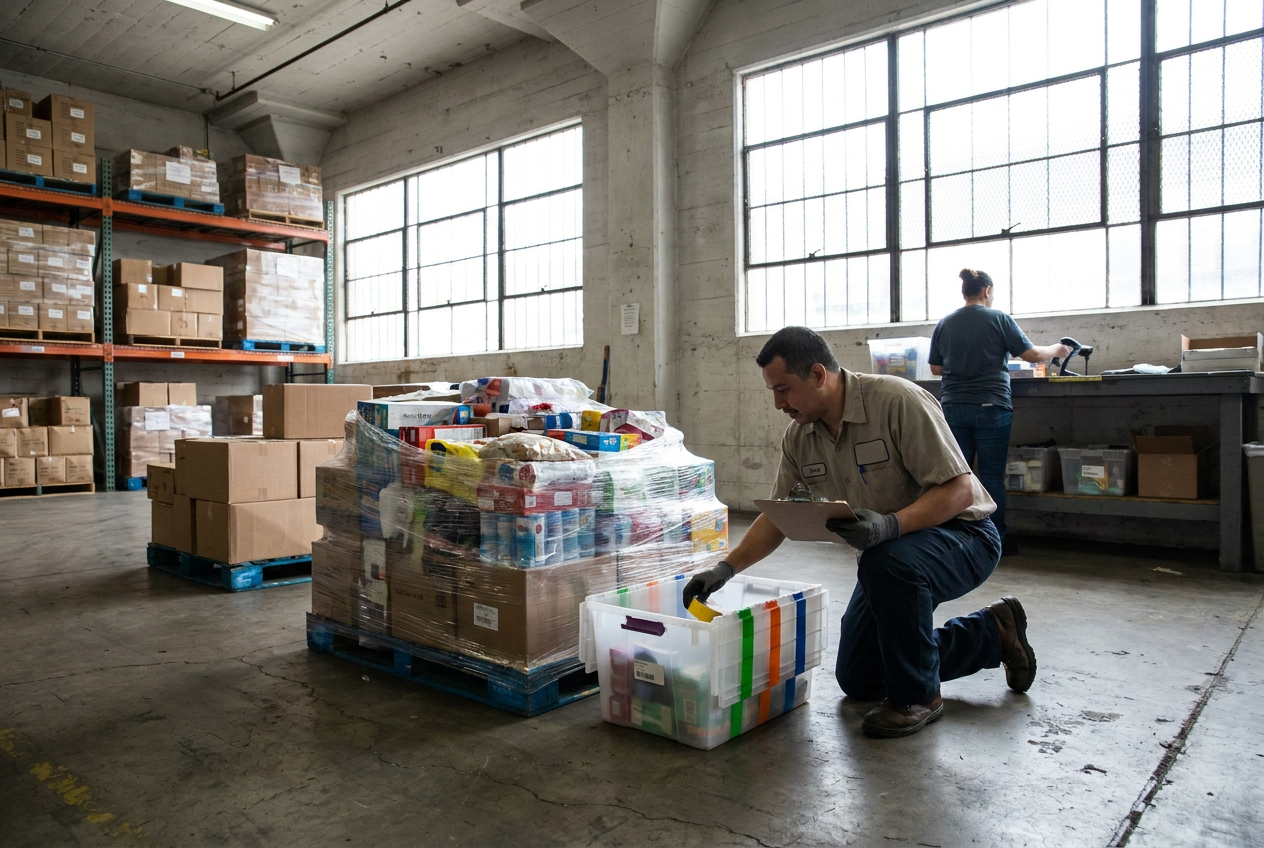
A liquidation pallet is a palletized wholesale lot of inventory sold for resale or other permitted handling. A truckload is a larger shipment marketed at load scale; verify the listing’s actual contents and shipment configuration. Neither label is a legal merchandise classification.
Category-level inventory can still contain products requiring separate review. A lot described as general merchandise is not assurance that every item can be sold through every channel.
Ordinary merchandise versus specially regulated goods
Housewares, apparel and many ordinary consumer products do not become subject to one universal state secondhand license merely because they are used. Nevertheless, local definitions, product safety rules and prohibited-product restrictions can still matter.
Escalate the review when a load includes:
- Mattresses or bedding, where sanitation and labeling questions require separate attention.
- Precious metals or jewelry, which may trigger specialized dealer rules depending on the activity.
- Vehicles, vehicle parts or scrap materials, which can involve distinct licensing systems.
- Firearms, medical products, food or cosmetics, which require product-specific analysis.
- Children’s products or electrical goods with recalls, missing safety components or uncertain identification.
For bedding, consult our Texas used-mattress resale requirements guide before accepting those items into saleable stock. A general business registration is not a substitute for that review.
Use listing categories as screening tools, not legal conclusions
Compare general merchandise liquidation inventory with available liquidation truckloads to understand the breadth of a proposed purchase. Then examine individual listings such as the Shoes Truckload and Amazon General Merchandise Truckload for the actual stated contents and condition.
These links are examples for listing review, not assertions of current availability, licensing exemptions or verified grades. PalletCove is an independent reseller and is not affiliated with, endorsed by or sponsored by any retailer named.
4. Verify condition, manifests and acquisition records
A condition grade is the seller’s description of inventory condition. Definitions vary across suppliers, so read the listing rather than assuming that a familiar grade has a universal meaning.
| Listing term | Practical meaning to investigate | What it does not establish |
|---|---|---|
| --- | --- | --- |
| Overstock | Inventory remaining beyond a seller’s needs | Automatic eligibility as explicitly NEW merchandise |
| Shelf pulls | Goods removed from a sales floor or display | Undamaged packaging or complete accessories |
| Customer returns | Merchandise returned by purchasers | Working condition or item-level testing |
| Mixed condition | A combination of conditions | One uniform grade across the load |
| Salvage | Goods potentially intended for repair, parts or recovery | Suitability for ordinary consumer resale |
| As-is | Sale subject to the listing’s stated condition terms | An exemption from safety laws or applicable policy rights |
A manifest is an inventory document describing the lot, potentially including item identifiers, descriptions and quantities. Confirm whether it is available, what fields it contains and whether quantities are represented as exact or approximate. A manifest is not automatically a testing report, authenticity determination or licensing document.
Ask the local authority whether wholesale invoices meet any acquisition-record requirements. If rules require individual seller identification, serial-number reporting or holding periods, a supplier invoice alone may not satisfy them. Also ask whether an exemption applies to the particular wholesale transaction and what evidence supports it.
Retain the listing, invoice, payment confirmation, manifest, delivery records and any written condition representations. Tie received goods to their purchase lot so that later inspection, sale or claims records remain traceable.
5. Apply the same checks across selling channels
A bin store sells merchandise from open bins, often using a scheduled pricing model. Before opening one, verify retail use, occupancy, public access and any applicable dealer requirements. The format does not change the legal identity of the merchandise.
A flea market is a venue where independent vendors sell from individual spaces or booths. Venue approval is separate from any permit or local registration that applies to the vendor. Our liquidation flea-market selling guide covers booth and stock planning without replacing that local check.
An online marketplace is a platform connecting sellers with buyers. Its account approval does not authorize inventory storage or customer pickups at a prohibited location. Build the listing workflow around accurate identification and condition disclosure, not assumptions from the wholesale title.
Sorting means separating received inventory by category, condition and disposition. A pricing strategy is the method used to set selling prices based on costs, condition, demand and channel expenses. Complete safety and compliance screening before pricing; a low price does not make a restricted product saleable.
For unsellable items, identify a lawful return, repair, recycling or disposal route. When scaling from pallets to truckloads, reassess storage, fire access, recordkeeping capacity and unloading arrangements. Our liquidation truckload buying guide addresses the broader purchasing transition.
6. Order only after the compliance and receiving checks
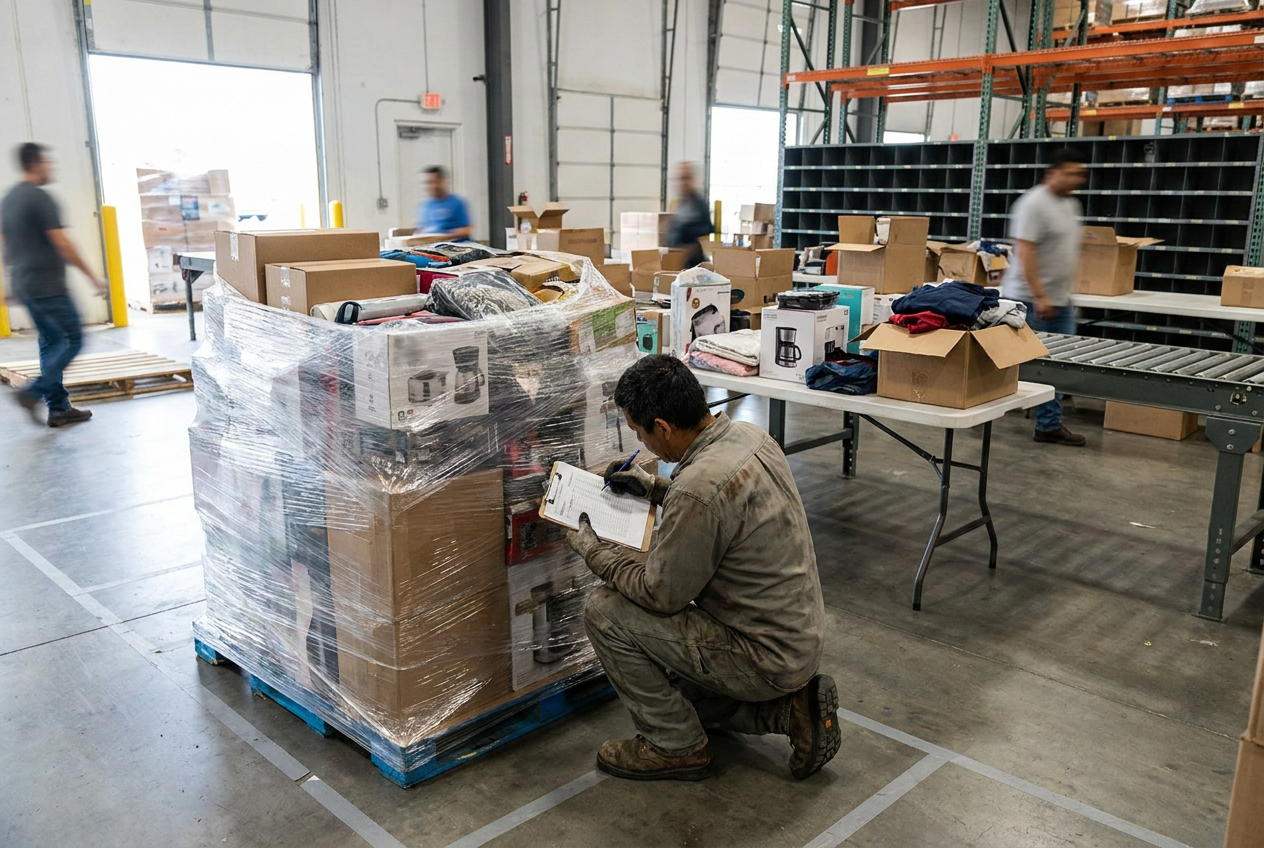
Use the liquidation pallets inventory hub to narrow the purchase, then confirm the listing’s lot size, condition, manifest availability and price basis. Determine whether the price covers a pallet, a multi-pallet lot or a full trailer. Do not convert a merchandise estimate into a promised resale value or profit projection.
Budget for your own sorting labor, storage, compliance work and lawful disposal. Larger quantities can increase those obligations even when the per-item purchase calculation looks attractive.
For geographic browsing, see liquidation pallets in Texas and liquidation pallets in Oklahoma. These are inventory destination pages, not evidence of permission to operate in either state.
PalletCove’s only delivery option is free shipping on every order to all 48 contiguous states; freight is included in the listed price. Confirm receiving-site access and unloading arrangements before ordering. LTL, or less-than-truckload, describes freight sharing trailer capacity; a full trailer describes a different shipment configuration. Verify which applies rather than assuming from the word “pallet.”
Payment methods are those shown at checkout: card via a secure payment link, ACH, bank wire and the listed payment apps. Handling takes 1–3 business days after payment clears, followed by typically 3–7 business days in transit from Dallas, for an estimated 4–10 business days total.
The processing cutoff is 2:00 PM Central Time, America/Chicago, Monday–Friday. After-cutoff confirmations begin the next business day; weekends and applicable holidays do not count. Plan opening dates around estimated timing rather than a guaranteed arrival day.
7. Inspect delivery and distinguish returns from claims
On delivery day, compare the shipment with the order documents, photograph its exterior condition and record visible damage or shortages on the delivery paperwork where possible. Preserve labels, packaging and relevant documents. Inspect safely during unloading, then separate questionable items before offering them for sale.
Request delivery-issue reporting within 48 hours so the issue can be documented promptly. That request does not shorten eligible new-product return rights.
Under the Refund & Returns Policy, United States products explicitly listed as NEW ONLY qualify for defective and non-defective returns and exchanges within 30 calendar days of delivery. Returns are by mail; the customer is responsible for the return label and shipping. A restocking fee of 15% of the product price applies.
Refund processing takes 10 calendar days after authorized return receipt and inspection, or approval where no physical return is required. Mixed and used loads have separate claims terms, not routine change-of-mind returns. Overstock, shelf-pull, customer-return and salvage descriptions must not be silently treated as NEW.
Common mistakes include treating an invoice as a license, relying on a neighboring city’s answer, overlooking regulated goods inside mixed inventory and selling items before a required holding period ends. Another is assuming “as-is” eliminates every policy obligation or product-safety responsibility.
Frequently asked questions
Is there one Texas secondhand dealer license for all resellers?
No universal statewide secondhand-dealer license covers every ordinary used-goods reseller. Verify municipal definitions, premises requirements and any specialized merchandise rules separately.
Does buying wholesale liquidation avoid municipal dealer rules?
Not automatically. Ask whether the ordinance distinguishes wholesale purchases from purchases from individuals, and obtain the applicable definition or exemption in writing.
Do online-only sellers need to check their business address?
Yes. Storage, home-business use, customer pickups and receiving activities can matter even when all listings appear online. Marketplace approval does not replace local permission.
Does a manifest prove that everything can be resold?
No. A manifest describes inventory to the extent stated, but does not establish safety, legal saleability, testing or regulatory compliance. Review the goods and applicable restrictions independently.
What should I do if the city’s answer is unclear?
Send a written description of the merchandise, sourcing method, addresses and selling channels, and request the controlling code provisions. If the ambiguity affects a lease or substantial purchase, seek advice from a qualified Texas attorney before proceeding.
Talk to PalletCove Liquidation
Resolve address and merchandise requirements first, then match inventory volume to your approved operation. Revisit our liquidation pallet purchasing guide for the broader buying process, contact our order desk with listing and receiving questions, or review current inventory.
PalletCove Liquidation LLC
4820 Cove Industrial Blvd, Dallas, TX 75236
Phone: (713) 819-3904
Email: sales@palletcoveliquidation.com
Hours: Mon–Fri 8:00 AM – 6:00 PM CT, Sat 9:00 AM – 2:00 PM CT, Sun closed.