
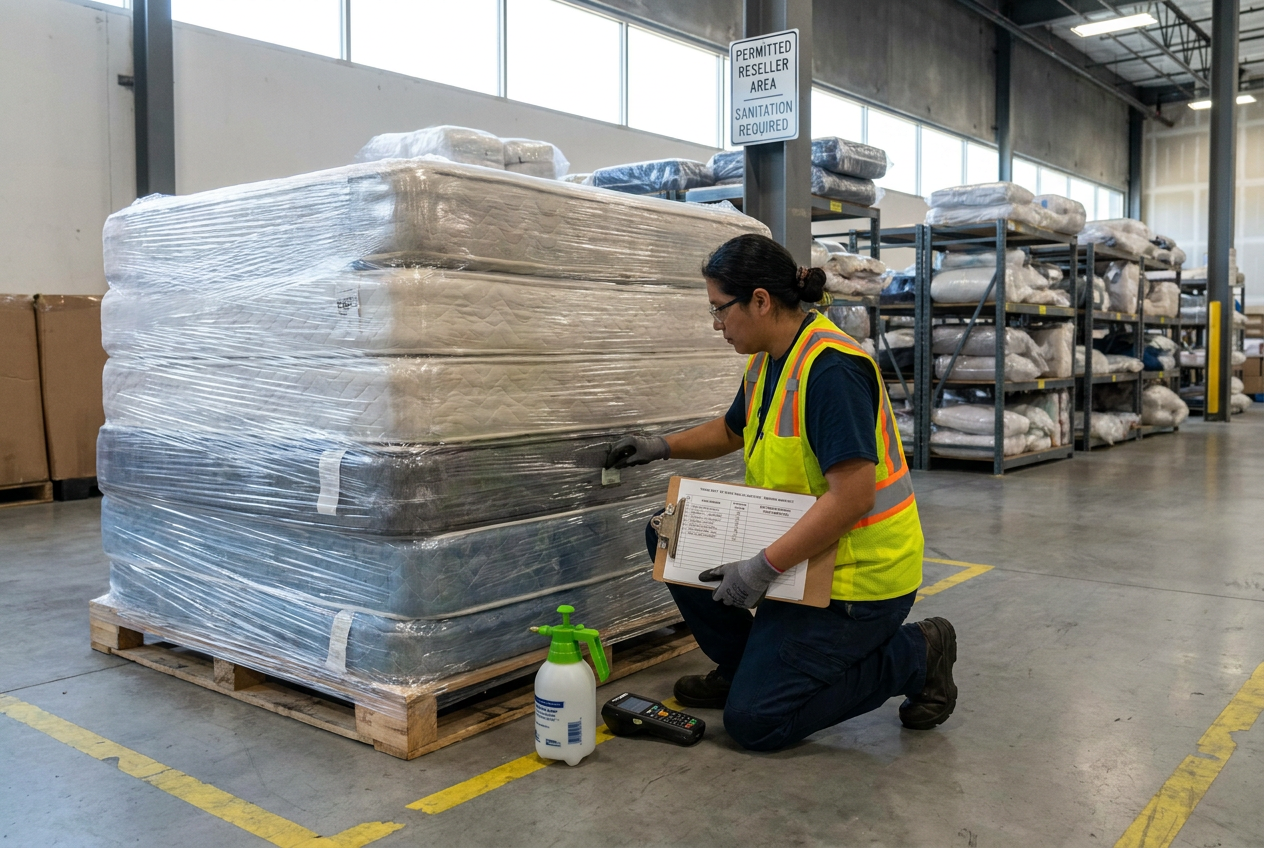
Searching for used mattress resale laws texas often brings up advice about sanitation permits and secondhand bedding labels without explaining whether those requirements are still in force. The essential starting point is that Texas repealed its bedding-specific statute, Health and Safety Code Chapter 345, effective September 1, 2015. Resellers should not treat requirements from that repealed program as current statewide obligations.
That does not make every returned mattress suitable for sale—or make an unsupported “new,” “sanitized” or “bedbug-free” claim acceptable. A reseller still needs to establish condition, check applicable local requirements, preserve product identification and investigate recalls or other safety restrictions. Returned bedding deserves a separate compliance decision before it enters saleable inventory.
For the broader purchasing process, use our guide to buying liquidation pallets. This article focuses on the narrower decision: what evidence and current requirements should determine whether a particular mattress can be offered for resale in Texas.
1. Start with the current Texas legal framework
The official Texas Health and Safety Code Chapter 345 page identifies the former bedding provisions as repealed. The official text of Texas Senate Bill 202 from the 84th Legislature provides the legislative record behind that change.
This matters because older guides may describe bedding registration, sanitization procedures, treatment permits or prescribed labels under the former Texas program. Those historical provisions are not a reliable present-day checklist. Texas no longer operates that bedding-specific regulatory scheme under Chapter 345.
However, repeal of one statute is not a universal exemption from other laws. The Texas Deceptive Trade Practices–Consumer Protection Act, particularly Section 17.46, addresses misleading representations, including representing goods as original or new when they are deteriorated, reconditioned, reclaimed, used or secondhand.
Before opening a resale operation, also ask the relevant city or county about zoning, occupancy, secondhand-business rules, storage, waste handling and any applicable local health requirements. Describe your actual activities: storing mattresses, selling them, cleaning them or rebuilding them may raise different questions.
The repeal of Texas’s bedding-specific law does not establish a mattress’s condition, prove sanitation or authorize misleading resale claims.
2. Classify returned bedding by evidence, not the load name
A customer return describes a supply-chain event, not a reliable legal or physical condition. A mattress may have been returned before delivery, opened without use or slept on during a trial period. A manifest entry saying “return” cannot distinguish those histories.
A condition grade is the supplier’s description of merchandise condition. Unless its criteria are documented, it is not a standardized inspection result. Similarly, “as-is” describes an allocation of condition risk; it does not establish sanitation or override applicable safety restrictions.
| Listing description | What it generally describes | What a mattress reseller must establish |
|---|---|---|
| --- | --- | --- |
| Overstock | Excess inventory | Whether the individual item remains unused, identifiable and consistent with the listing |
| Shelf pulls | Merchandise removed from a sales floor | Display exposure, handling, packaging changes and possible use |
| Customer returns | Merchandise returned by a purchaser | Delivery history, possible sleep use, damage and available documentation |
| Mixed condition | Several conditions within one lot | An item-specific disposition rather than one blanket grade |
| Used | Prior use is acknowledged | Actual condition, safety concerns and truthful disclosure |
| Salvage | Recovery, repair or disposal-oriented merchandise | Whether any lawful resale route exists; do not assume consumer readiness |
An unopened-looking wrapper is not conclusive evidence of an unused mattress: products can be rewrapped. Conversely, damaged packaging alone does not prove sleep use. When history is incomplete, do not upgrade the item to “new” merely because no stain is visible.
Sorting, the process of separating inventory by condition and disposition, should produce at least three groups: documented sale candidates, items held for investigation, and items excluded from consumer sale. Keep excluded bedding away from cleared stock.

3. Verify sanitation, labels and permissions separately
Sanitation is a factual claim, not a marketing shortcut
Do not apply a historical Texas sanitation requirement as though Chapter 345 remained active. Instead, determine what requirements apply to your location, operations and destination market, and obtain professional advice where contamination or infestation is suspected.
Vacuuming, fragrance application, surface wiping or replacing a cover does not, by itself, substantiate broad claims such as “sterilized” or “bedbug-free.” If a service provider performs treatment, retain its invoice, method, date, item identification and any limits on what the service establishes. Those records support only the claims the actual work justifies.
For pests, isolate suspect inventory and consult an appropriately licensed pest-management provider. Do not improvise pesticide applications on sleeping surfaces; product-label restrictions matter. Material showing significant moisture damage, mold concerns or biological contamination should be held out of sale while its disposition is assessed.
Labels require their own review
The repeal of the Texas bedding program should not be interpreted as permission to remove all mattress labels. Preserve manufacturer identification, model information, manufacturing dates, warnings and other original markings. They help establish product identity and support recall checks.
Federal mattress flammability standards and associated labeling provisions are separate from the repealed Texas law. The U.S. Consumer Product Safety Commission mattress guidance explains the relevant federal framework. Rebuilding or materially altering a mattress can raise obligations different from those of a seller passing along an intact used item.
If identification is missing, quarantine the item until you understand the implications. Do not create a substitute label that implies manufacturer certification or regulatory approval.
A resale certificate is not a bedding permit
A resale certificate is a purchasing document; it does not authorize sanitation work or certify mattress safety. Valid resale certificates are reviewed and applied where the buyer’s state allows.
Ask local authorities whether your specific operation needs any business, occupancy or activity-specific approval. If you sell across state lines, investigate destination-state bedding rules rather than assuming Texas’s repeal applies everywhere.
4. Build a buying file before committing to a load
A liquidation pallet is a grouped wholesale inventory unit. A truckload is a larger purchase commonly planned around a full trailer. Neither format establishes that bedding is included, unused or ready for resale.
Start with the liquidation pallets inventory hub, then narrow by the actual listing. The general merchandise category and truckload category describe different purchasing scopes, not bedding compliance outcomes.
A listing such as the Macy’s Textile Truckload should be evaluated against its current contents; “textile” does not automatically mean mattresses. Likewise, the Amazon General Merchandise Truckload is not evidence that any particular bedding product is present. PalletCove is an independent reseller and is not affiliated with, endorsed by or sponsored by any retailer named.
Request the following before ordering:
- The current manifest: an inventory list, with available quantities, descriptions, identifiers and condition information.
- The condition definitions: what the supplier means by returns, mixed, used or salvage.
- Available history: whether delivery, opening, trial use or treatment is documented.
- Identification photographs: labels and packaging, where available—not an assumption that every item has been individually tested.
- The transaction terms: what is included, what remains unknown and which claims process applies.
- A receiving plan: storage, isolation space, unloading capability and inspection staffing.
A manifest is useful purchasing evidence, not proof of sanitation. Verify whether it is an exact inventory record, an estimate or another form of description under the listing terms.
5. Price for uncertainty and plan the order
A pricing strategy is the method used to set buying limits and selling prices based on condition, costs and demand. For bedding, it should account for documentation gaps and items that never become saleable—not just visible cosmetic differences.
Use the listed purchase price plus your own receiving, storage, assessment, legitimate treatment and disposal costs to evaluate the purchase. Do not divide the lot price by the manifest count and assume every unit can be sold. Our liquidation pallet buying-limit guide covers the broader calculation without substituting for mattress-specific review.
PalletCove’s only delivery option is free shipping on every order to all 48 contiguous states; freight is included in the listed price. Handling takes 1–3 business days after payment clears, and transit is typically 3–7 business days from Dallas, for an estimated 4–10 business days total.
The processing cutoff is 2:00 PM Central Time, America/Chicago, Monday–Friday. After-cutoff confirmations begin the next business day; weekends and applicable holidays do not count. Payment methods are those shown at checkout: card via a secure payment link, ACH, bank wire and the listed payment apps.
Confirm whether the shipment is arranged as LTL—less-than-truckload freight—or a full trailer, and verify receiving requirements before ordering. For larger purchases, consult our guide to buying liquidation truckloads.
Buyers comparing liquidation pallets in Texas with liquidation pallets in Florida should distinguish shipping availability from resale legality. Included shipping does not make destination-state bedding requirements identical.
6. Inspect delivery, preserve evidence and choose the sales channel
On delivery day, photograph the load before unpacking where practical. Record visible wrapping damage, moisture, package discrepancies and available item identifiers. Keep suspect bedding isolated rather than placing it directly on a retail floor.
Check identifiable products against CPSC recalls. Do not sell a recalled product simply because it looks usable; determine the applicable remedy and restrictions first. Maintain records connecting each sale candidate to its source, condition assessment and any treatment documentation.
PalletCove requests delivery-issue reporting within 48 hours. That request does not shorten eligible new-product return rights. Under the Refund & Returns Policy, United States products explicitly listed as NEW ONLY qualify for defective and non-defective returns and exchanges within 30 calendar days of delivery, by mail. Customers are responsible for the return label and shipping; the restocking fee is 15% of the product price. Refund processing takes 10 calendar days after authorized return receipt and inspection, or approval where no physical return is required. Mixed/used loads have separate claims terms, not routine change-of-mind returns.

An online marketplace is a platform connecting sellers and buyers; its used-bedding policies can be stricter than state law. Follow the Facebook Marketplace listing workflow for general listing organization, but verify the platform’s current mattress rules separately.
A flea market is a venue where independent vendors sell from booths or stalls. Check venue restrictions before transporting bedding; our flea-market stock planning guide covers that channel more broadly. A bin store, a shop selling grouped merchandise from bins, also needs a separate, suitable bedding-handling process rather than treating mattresses like small general merchandise.
Starting a bin store, handling unsellable items and scaling to truckloads all require broader planning. Here, the immediate rule is narrower: do not list held inventory, conceal use or donate questionable bedding without checking the recipient’s acceptance requirements.
Frequently asked questions
Is selling a used mattress illegal in Texas?
Texas’s former bedding-specific statute was repealed effective September 1, 2015; that chapter is not a current statewide prohibition or permit system. Particular sales can still raise consumer-protection, recall, safety, local-rule or destination-state issues.
Does Texas require a used-mattress sanitation permit?
The former Chapter 345 bedding program is no longer in force. Verify any requirements applicable to your location and actual activities, especially if you treat pests, rebuild bedding or ship into another state.
Can a customer-return mattress be advertised as new?
Not merely because it looks clean or has packaging. Establish its history and actual condition, and avoid new-condition claims where prior use or other contrary facts make that description misleading.
Is a secondhand tag enough to make a mattress saleable?
No. A tag does not resolve contamination, recalls, missing identification or unsupported treatment claims, and an old Texas labeling rule should not be presented as current law.
What should I do when the mattress history is unknown?
Hold it out of sale while seeking supplier records and assessing condition and identification. If you cannot establish a defensible resale route, use an appropriate disposal or recovery channel rather than inventing a condition grade.
Talk to PalletCove Liquidation
Before buying returned bedding, separate the legal question from the inventory question: confirm applicable rules, then evaluate what the specific listing and available records actually establish. Return to our liquidation pallet purchasing guide for the broader buying framework.
PalletCove Liquidation LLC is located at 4820 Cove Industrial Blvd, Dallas, TX 75236. Call (713) 819-3904 or email sales@palletcoveliquidation.com. Hours are Mon–Fri 8:00 AM – 6:00 PM CT, Sat 9:00 AM – 2:00 PM CT, Sun closed.
For listing details and available documentation, contact our order desk and review current inventory. Confirm mattress contents and condition from the actual listing rather than assuming any pallet or truckload includes bedding.